Closing Gaps Between Teeth in Marsden Park
Gaps between teeth — dentists call them diastemata — are one of the most common cosmetic concerns we see at our Dentist Marsden Park practice. MM Dental treats them as part of our cosmetic dentistry and orthodontics services for patients across Marsden Park, St Marys, Schofields and the wider northwest Sydney corridor. This page covers what causes gaps, the four treatment options that actually work, the realistic cost picture, and how to know which option is right for a specific case.
The honest opening: a gap is rarely a single-cause problem. The right treatment depends on the size of the gap, the cause, the patient’s age, and whether they want the gap fully closed or just less obvious. A 1mm midline gap in a 25-year-old and a 4mm generalised spacing in a 55-year-old are different cases with different answers.
What causes a gap between teeth?
A gap between teeth is most commonly caused by a size mismatch between the teeth and the jaw, a prominent labial frenum, periodontal disease, or a habit such as thumb-sucking in childhood. The Australian Dental Association and Better Health Channel describe the cause as the first thing to establish, because the treatment changes with the cause.
The most common causes, ranked by frequency:
- Tooth-jaw size mismatch — the teeth are too small for the jaw, or the jaw is too wide for the teeth. The result is generalised spacing, often across all the front teeth, with or without a midline gap. Common and usually familial.
- Prominent labial frenum — the tissue attaching the upper lip to the gum is unusually thick or low. It sits between the two upper central incisors and prevents them from coming together. A frenectomy (surgical release) is often needed to allow the gap to close.
- Periodontal (gum) disease — in adults, gum disease can cause teeth to drift and gaps to open, particularly between the upper front teeth. This is a different problem: the cause is gum disease, and the treatment has to start there.
- Thumb-sucking or tongue thrust habit in childhood — prolonged habits push the front teeth forward and create or worsen a midline gap. The habit usually stops by age 7-8; if the gap persists, it often needs active treatment.
- Missing or undersized lateral incisors — if the lateral incisors (the teeth either side of the two front teeth) are missing or small, the central incisors drift into the space and the gap appears.
- Previous orthodontic relapse — a gap that was closed with braces in childhood and then opened again because retainers were dropped.
The right treatment depends on the cause. A gap from a prominent frenum needs a frenectomy before any other treatment. A gap from periodontal disease needs the gum disease treated first. A gap from a tooth-jaw size mismatch usually responds to orthodontics or bonding.
What are the options for closing a tooth gap?
There are four reliable options for closing a tooth gap: composite bonding, porcelain veneers, orthodontic treatment (braces or clear aligners), and — for missing teeth — a bridge or implant. Each option suits a different case. The ADA’s cosmetic dentistry guidance and Better Health Channel’s teeth-straightening page describe the four options in detail.
The four options side by side:
| Option | Best for | Time | Invasiveness | Lifespan |
|---|---|---|---|---|
| Composite bonding | Small gaps (1-3mm), healthy teeth, patient wants minimal cost and minimal drilling | 1 visit | None — no tooth removal | 5-8 years |
| Porcelain veneers | Small to medium gaps, patient wants a shape change as well as a gap closure | 2-3 visits | Irreversible — enamel removed | 10-15 years |
| Clear aligners | Medium to large gaps, multiple teeth involved, patient wants to keep all natural tooth structure | 6-18 months | None | Permanent (with retainer) |
| Frenectomy + orthodontics | Midline gap caused by a prominent frenum, particularly in children and teens | 6-12 months (after frenectomy heals) | Minor surgery for frenum | Permanent (with retainer) |
The case for composite bonding: it is the lowest-cost, lowest-invasiveness, fastest option for a small gap. The case for orthodontics: it preserves the natural tooth structure and addresses the underlying cause. The case for veneers: the patient also wants a shape or colour change. The case for a bridge or implant: a tooth is missing and the gap is the space.
The wrong answer for most patients: doing nothing. A gap is rarely health-threatening, but it can affect confidence and, in some cases, speech (particularly the “s” and “sh” sounds).
What does composite bonding for gaps actually look like?
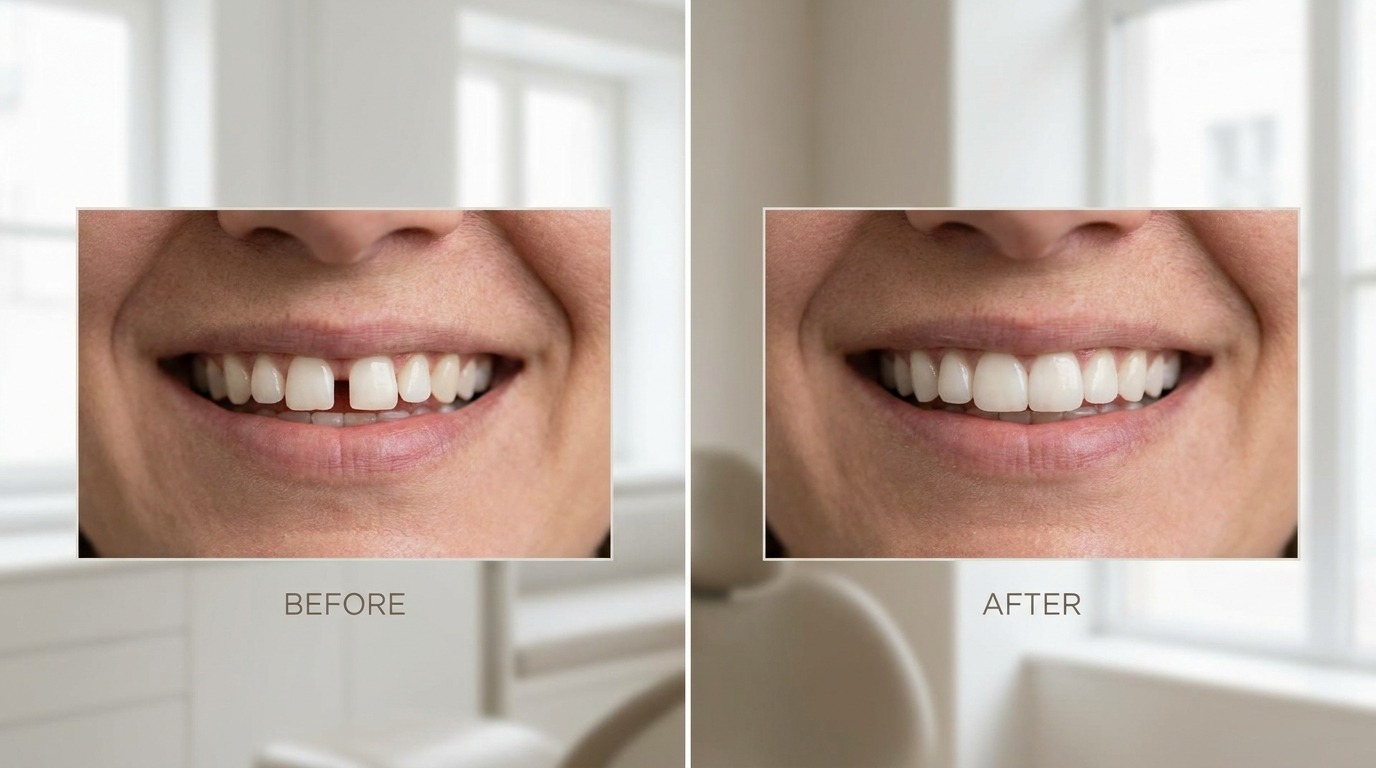
Composite bonding for a gap is a single-visit procedure where tooth-coloured resin is added to the sides of the adjacent teeth, shaped to close the space, hardened with a blue curing light, and polished to match the natural teeth. No drilling. No anaesthetic. No temporary. The ADA’s cosmetic dentistry guidance describes bonding as the most conservative option for small diastemata.
The procedure, step by step:
- Shade match — the dentist selects a composite shade that matches the natural teeth. For a single gap, the matching is usually straightforward. For multiple teeth, a layered approach with two shades is sometimes used.
- Surface preparation — the sides of the adjacent teeth are etched with a mild acid gel, and a bonding agent is applied. This is what holds the composite in place. No drilling, no anaesthetic.
- Composite placement — the dentist builds up the composite in small increments, each one shaped and light-cured before the next is added. The art is in the shaping — the dentist has to build a natural-looking emergence profile, a contact point with the neighbouring tooth, and a contour that matches the rest of the smile.
- Polish — the composite is polished to a high shine. The final result is indistinguishable from natural tooth structure to a non-dentist.
- Review — a 2-week check to see how the contact point is settling and to polish any rough edges.
The whole appointment takes 30-90 minutes per gap. Multiple gaps can be done in a single visit. The result is immediate.
The honest framing: composite bonding is fast, conservative, and relatively inexpensive. It is also the option that needs replacement most often. The composite picks up stain over time (coffee, tea, red wine), and the edges can chip. A bonded gap typically lasts 5-8 years before needing a refresh.
What does orthodontic treatment for gaps look like?
Orthodontic treatment for gaps uses clear aligners (Invisalign) or fixed braces to gently move the teeth together, closing the gap over 6-18 months depending on the case. The result is permanent (with a retainer), and the natural tooth structure is fully preserved. The Better Health Channel’s teeth-straightening page is the standard Australian patient reference for orthodontic options.
When orthodontics is the right answer:
- Multiple gaps — closing several gaps with bonding means building up many teeth, which is expensive and looks bulky. Moving the teeth with orthodontics is cleaner and more durable.
- Larger gaps — gaps over 3mm are difficult to close with bonding alone. The teeth would look unnaturally wide.
- Patients who want to keep all natural tooth structure — orthodontics does not require any drilling. Veneers and bonding both do (veneers more than bonding).
- Younger patients — the gums and bone respond better to tooth movement in younger patients. An adult can still be treated, but the case takes longer.
When orthodontics is the wrong answer:
- Patient wants the result in 1 visit — orthodontics takes months.
- Patient does not want to wear a retainer for life — without a retainer, the teeth drift back. A bonded or removable retainer is a long-term commitment.
- The cause of the gap is gum disease — moving teeth in a diseased gum is a bad idea. The gum disease has to be treated first.
The combination of frenectomy plus orthodontics is the right answer for a midline gap in a child or teen with a prominent frenum. The frenum is released surgically (a 5-minute procedure under local anaesthetic), the area heals for 2-3 weeks, and orthodontic treatment then closes the gap. The success rate is high.
How much does it cost to close a tooth gap in Marsden Park?
In Australia, composite bonding for a small gap costs roughly $250-$500 per tooth, porcelain veneers $1,500-$2,800 per tooth, and clear aligner orthodontics $6,000-$9,000 for a single-arch case. The wide range reflects the case complexity, the materials, and the dentist’s experience. The Australian Dental Association’s annual fee survey is the standard practitioner reference for the cost framework, and Healthdirect’s dental-care page is the patient-side reference.
The honest cost breakdown:
- Composite bonding (single small gap) — $250-$500 per tooth, often two teeth per gap. The lower-cost entry point. Reversible. Lasts 5-8 years.
- Composite bonding (multiple gaps) — $250-$500 per tooth, more teeth = higher total. A 6-tooth bonding case is $1,500-$3,000.
- Two porcelain veneers (single small gap) — $3,000-$5,600. The aesthetic premium. Irreversible. Lasts 10-15 years.
- Clear aligners (Invisalign) — $6,000-$9,000 single arch, $8,000-$12,000 both arches. The conservative option, but takes 6-18 months and requires lifetime retainer wear.
- Frenectomy (if needed) — $300-$800. Often a prerequisite for orthodontic closure of a midline gap.
The honest answer for a Marsden Park patient: book a consultation. The dentist will look at the cause, the size, and the bite, and recommend the right option (or combination). The cost discussion is part of the same visit.
What if the gap keeps coming back?
A gap that reopens after treatment is usually caused by an unresolved underlying factor — a prominent frenum, periodontal disease, missing lateral incisors, or failure to wear a retainer after orthodontics. The ADA’s position on cosmetic dentistry and Better Health Channel both emphasise that the cause has to be addressed before the closure is attempted.
The patterns we see at our chair:
- Bonding that falls off within a year — usually a bonding technique issue, not a patient issue. Re-bonding with a different technique or a different dentist usually fixes it.
- Bonding that discolours within 2-3 years — the patient is a heavy coffee or red wine drinker, or a smoker. The composite is doing what composites do. A repolish or replace is the answer.
- Orthodontic closure that reopens — failure to wear a retainer, or an unresolved frenum. The frenum has to be released surgically before the orthodontic case is finished, not after.
- Gap that opens in an older adult — periodontal disease causing teeth to drift. The gum disease is the problem; the gap is a symptom. Treating the gum disease first is non-negotiable.
The honest framing: a gap is rarely a single-treatment problem. The case planning — understanding the cause, choosing the right treatment, addressing the underlying factors — is the part that determines whether the result lasts.
Frequently asked questions (supplementary)
Is a tooth gap bad for my health? Not usually. A small midline gap is mostly a cosmetic concern. A larger gap can affect speech (the “s” sound) and can put unusual forces on the neighbouring teeth. Most adults with a stable small gap have no functional issues.
Can I close a gap without braces? Yes — composite bonding or veneers can close a small gap in 1-2 visits. Orthodontics is the right answer for multiple gaps or larger gaps.
Does bonding damage teeth? No. Bonding adds to the tooth; it does not remove any natural tooth structure. The downside is that the bonding may need replacement every 5-8 years.
Will the gap come back after bonding? Possibly. The composite can chip or debond if the bite is heavy on the bonded teeth. A night guard is often recommended for grinders.
How long does Invisalign take for a gap? Typically 6-12 months for a single midline gap, 12-18 months for generalised spacing. A retainer is required for life to prevent relapse.
Ready to start?
A 30-minute consultation at our Dentist Marsden Park practice is the right place to start. We will look at the cause, the size, and the bite, and recommend the right option for your case — bonding, veneers, orthodontics, or a combination. We regularly see patients from neighbouring St Marys and across the wider northwest Sydney corridor. Book online or call our practice.