Stained & Discoloured Teeth Treatment in Marsden Park
Tooth discolouration is one of the most common aesthetic concerns we see at our Dentist Marsden Park practice. MM Dental provides professional teeth whitening as part of our cosmetic dentistry service for patients across Marsden Park, St Marys, Schofields and the surrounding northwest Sydney suburbs. This page covers what actually stains teeth, the difference between extrinsic and intrinsic discolouration, the professional whitening options that work, what to skip, and how to keep the result.
The most useful thing to know upfront: not all stains are the same. A scale and clean will fix some. A professional whitening will fix most. But some intrinsic stains need veneers or bonding, not bleach.
What is the difference between extrinsic and intrinsic staining?
Extrinsic staining sits on the surface of the enamel and comes from food, drink, tobacco, and poor oral hygiene. Intrinsic staining is within the tooth structure and comes from medication, trauma, age, or genetics — and it does not respond to surface cleaning. The Australian Dental Association and Better Health Channel’s whitening page both describe this as the most important first distinction when a patient asks about whitening.
The two types side by side:
| Property | Extrinsic | Intrinsic |
|---|---|---|
| Where it lives | On the enamel surface | Within the dentine, under the enamel |
| Common causes | Coffee, tea, red wine, tobacco, curry, betel nut | Tetracycline antibiotics, fluorosis, trauma, ageing, genetics, root canal treated teeth |
| Responds to cleaning | Yes — scale and clean often removes it | No |
| Responds to whitening | Yes | Sometimes (yellow-brown yes, grey-white no) |
| Best treatment | Professional clean + whitening | Whitening attempt first; veneers or bonding if no result |
The common causes worth knowing:
- Coffee, tea, red wine — the big three. Tannins in tea and red wine bind to enamel. Coffee is the worst offender for habitual drinkers because of the chromogens (colour molecules) plus the acidity.
- Tobacco — nicotine and tar combine to produce the brown-to-black staining on the inside surfaces of front teeth in long-term smokers.
- Curry, soy sauce, balsamic vinegar — strong pigments that stick to plaque.
- Chlorhexidine mouthwash — paradoxically stains teeth brown when used for more than 2 weeks. Common after oral surgery.
- Tetracycline staining — if you took tetracycline antibiotics as a child while your adult teeth were forming, the antibiotic bound to the developing dentine and produced yellow-brown or grey banding. This is permanent and does not bleach out.
- Fluorosis — too much fluoride during tooth development (typically well above the public water supply levels) produces white spots or brown mottling. Mild cases can be polished; severe cases need veneers.
- Trauma — a single tooth that was hit goes grey or yellow-brown over months to years as the nerve dies. Often needs root canal first, then internal bleaching of the tooth from inside.
- Ageing — the enamel thins with age, the yellow dentine underneath shows through more. A natural shade change, not pathology.
What are the professional whitening options?
There are three professional whitening options: in-chair whitening (single visit, immediate result), take-home custom trays (1-2 weeks of nightly wear), and internal bleaching for a single root-canal-treated tooth. Most patients do a combination: in-chair to start, take-home to maintain. The Better Health Channel is the standard Australian patient reference for the options.
The three options, ranked by how often we use them at our chair:
- Take-home custom trays — the workhorse. Impressions are taken, custom trays are fabricated, the patient wears them with a 10-16% carbamide peroxide gel for 30-90 minutes a day for 7-14 days. The shade lifts 4-8 shades over the course of treatment. The trays are kept for future top-ups (1-2 nights every 6-12 months).
- In-chair whitening — a 60-90 minute appointment. The gums are protected with a rubber dam or gingival barrier, a high-concentration hydrogen peroxide gel (25-40%) is applied to the teeth, often activated by a special light. The shade lifts 4-8 shades in a single visit. More expensive than take-home. Best for patients who want immediate results or who are unlikely to comply with a 2-week take-home protocol.
- Internal bleaching — for a single discoloured root-canal-treated tooth. The dentist opens the back of the tooth, places a peroxide walking bleach inside, and seals it for 1-2 weeks. The whitening works from the inside out. Often combined with external whitening to match the surrounding teeth.
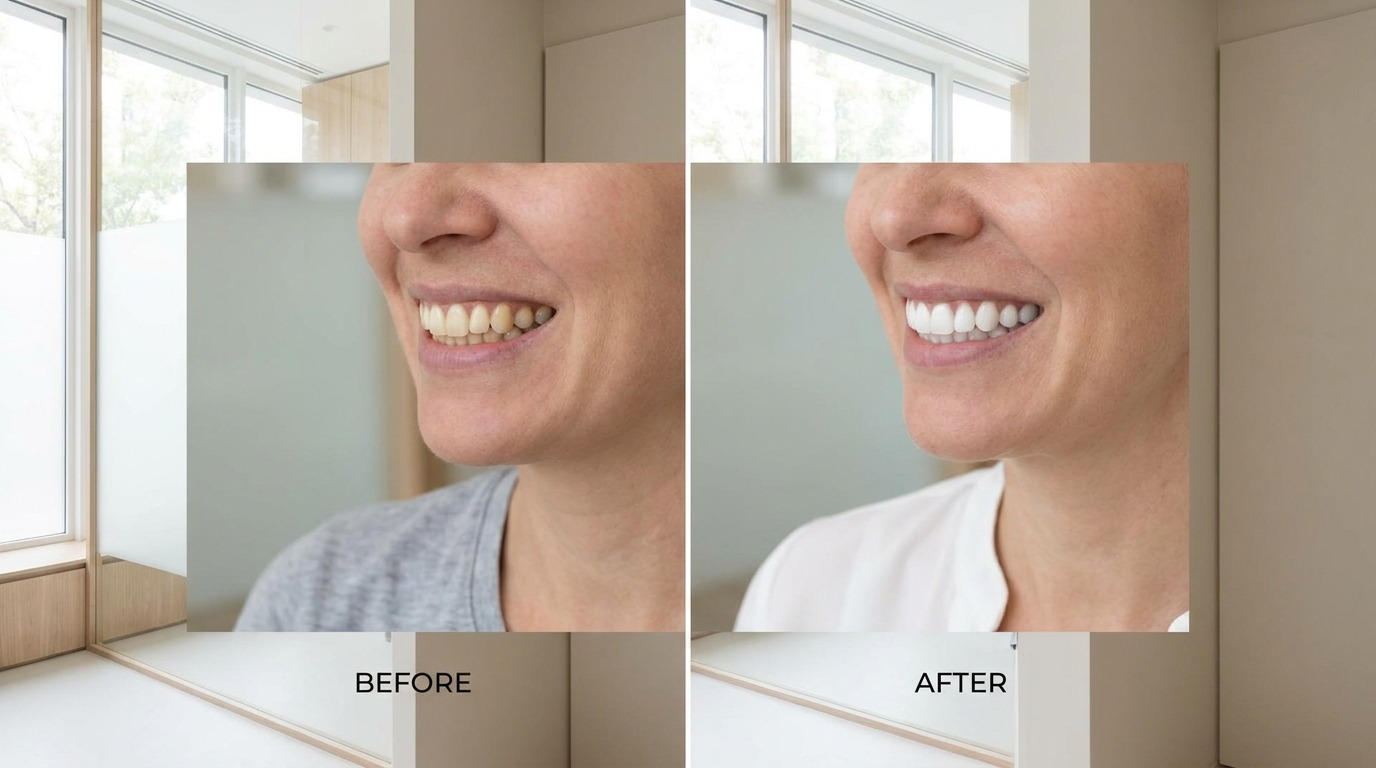
The honest comparison: in-chair is faster and more dramatic, take-home is more controllable and cheaper, and a combination approach usually gives the best long-term result. Over-the-counter strips and gels are weaker and less predictable, but they have their place for a low-budget touch-up.
Is teeth whitening safe?
Professional teeth whitening is safe when supervised by a dentist, with the most common side effect being temporary tooth sensitivity affecting up to two-thirds of patients during treatment. The Australian Dental Association describes whitening as a well-established procedure with a strong safety record when used as directed. Sensitivity usually resolves within a few days of stopping treatment.
The safety picture:
- Active ingredient — hydrogen peroxide or carbamide peroxide, both of which break down to water and oxygen. The active oxygen is what bleaches the stain molecules.
- Tooth sensitivity — the most common side effect. The peroxide dehydrates the tooth temporarily, exposing the dentine tubules to thermal stimuli. Higher-concentration products and longer wear times increase the risk. Desensitising toothpaste used for 2 weeks before treatment reduces the risk.
- Gum irritation — the gel burns the soft tissues if it contacts them. In-chair whitening uses a gingival barrier; take-home trays are custom-fitted to minimise the leak. Any white patches on the gum resolve within an hour.
- Enamel damage — no evidence of permanent enamel damage from professionally supervised whitening at the concentrations used in dental practice. Higher-concentration unsupervised products are a different story.
- Existing dental work — whitening does not change the colour of crowns, veneers, or fillings. If you have a visible restoration on a front tooth, you may need to replace it after whitening to match the new shade.
- Pregnancy — most dentists defer whitening during pregnancy and breastfeeding as a precaution, not because of evidence of harm.
How long does the whitening result last?
Professional whitening results typically last 1-3 years for most patients, with the longest retention in patients who avoid the staining causes (coffee, tea, red wine, tobacco) and who maintain with a top-up every 6-12 months. The take-home trays are kept and used for a 1-2 night top-up whenever the shade starts to drift.
What affects longevity:
- Diet — heavy coffee, tea, or red wine drinkers see faster relapse. Straw-drinking the staining beverages reduces the contact.
- Tobacco — smoking reverses the result quickly. Patients who quit smoking and then whiten get the longest-lasting result.
- Home care — good brushing, flossing, and regular scale and clean appointments keep the surface clean and the result bright.
- Top-up frequency — 1-2 nights every 6-12 months with the existing trays. Most patients do this and maintain the result for years.
- Starting shade — yellower teeth respond better and stay whiter longer than greyish teeth.
The honest framing: whitening is not a one-time treatment. It is a starting point. The take-home trays are the long-term maintenance tool, and the patients who keep using them get the best long-term result.
What about veneers and bonding for stained teeth?
Veneers and bonding are the right answer for intrinsic stains that do not respond to whitening — typically tetracycline staining, fluorosis, and single dark root-canal-treated teeth. Both options sit on top of the natural tooth and can be made in any shade.
The comparison:
- Composite bonding — tooth-coloured resin applied directly to the tooth surface, shaped, and polished. One visit. Less expensive than veneers. Lasts 5-8 years before needing replacement. Best for small areas and minor discolouration.
- Porcelain veneers — thin shells of porcelain bonded to the front of the teeth. Two visits. More expensive than bonding. Last 10-15 years. Best for full-smile makeovers and severe intrinsic staining.
- Combination — whitening first to a base shade, then veneers or bonding on the teeth that did not respond.
The decision is genuinely individual. A consultation with the dentist, sometimes with a digital smile preview, is the right way to work out which option suits the case.
What actually doesn’t work for stained teeth?
Whitening toothpastes only remove surface staining and do not change the underlying tooth colour. Charcoal toothpastes are abrasive and can damage enamel. Oil pulling has no convincing evidence for whitening. Lemon juice and baking soda are acidic and erode enamel — a net negative. The Better Health Channel and the ADA are clear on these.
The things to skip:
- Activated charcoal toothpaste — does not whiten. The abrasive action wears enamel over time, which actually makes the underlying yellow dentine more visible. Net negative.
- Whitening toothpaste as a substitute for professional whitening — useful as maintenance after professional whitening, but will not change the underlying shade. The abrasive content is also higher than regular toothpaste.
- Lemon juice and baking soda home remedies — acidic and abrasive. Will damage enamel within a few uses. The dentine underneath shows through more, making the tooth look more yellow. Net negative.
- Oil pulling — no evidence for whitening. May have some plaque-reducing benefit but is not a substitute for brushing.
- Hydrogen peroxide from the chemist — low concentration (3-6%) and not formulated for oral use. Higher concentration without supervision risks chemical burns to the gums.
The pattern is: anything that sounds like a quick fix from a kitchen or a pharmacy shelf is either ineffective, harmful, or both. Professional whitening under dental supervision is the only option that reliably changes the underlying tooth shade.
Frequently asked questions (supplementary)
Will whitening damage my enamel? No, not at professionally supervised concentrations. Studies show no permanent enamel damage from carbamide or hydrogen peroxide at the strengths used in dental practice.
Can I whiten if I have crowns or veneers? The whitening does not affect existing dental work. The natural teeth will lighten, the restorations will not, and you may need to replace the restorations to match the new shade.
How white can my teeth realistically get? It depends on the starting shade. Yellow-brown teeth respond best. Greyish teeth (often from tetracycline or ageing) lighten less predictably. The realistic ceiling is roughly where the dentine colour is — you cannot whiten beyond what your natural tooth structure allows.
Does whitening hurt? Some patients get sensitivity during treatment. Desensitising toothpaste used for 2 weeks before and during treatment reduces the risk. Ibuprofen helps. Sensitivity resolves within days of stopping.
Is in-chair better than take-home? Both work. In-chair is faster and more dramatic. Take-home is cheaper and gives more control over the final shade. Many patients do both — in-chair to start, take-home to maintain.
Ready to start?
A 30-minute consultation at our Dentist Marsden Park practice is the right place to start. We will assess the cause of the discolouration, recommend the right approach (clean only, whitening, bonding, or veneers), and quote the case. We regularly see patients from neighbouring St Marys and across the wider northwest Sydney corridor. Book online or call our practice.