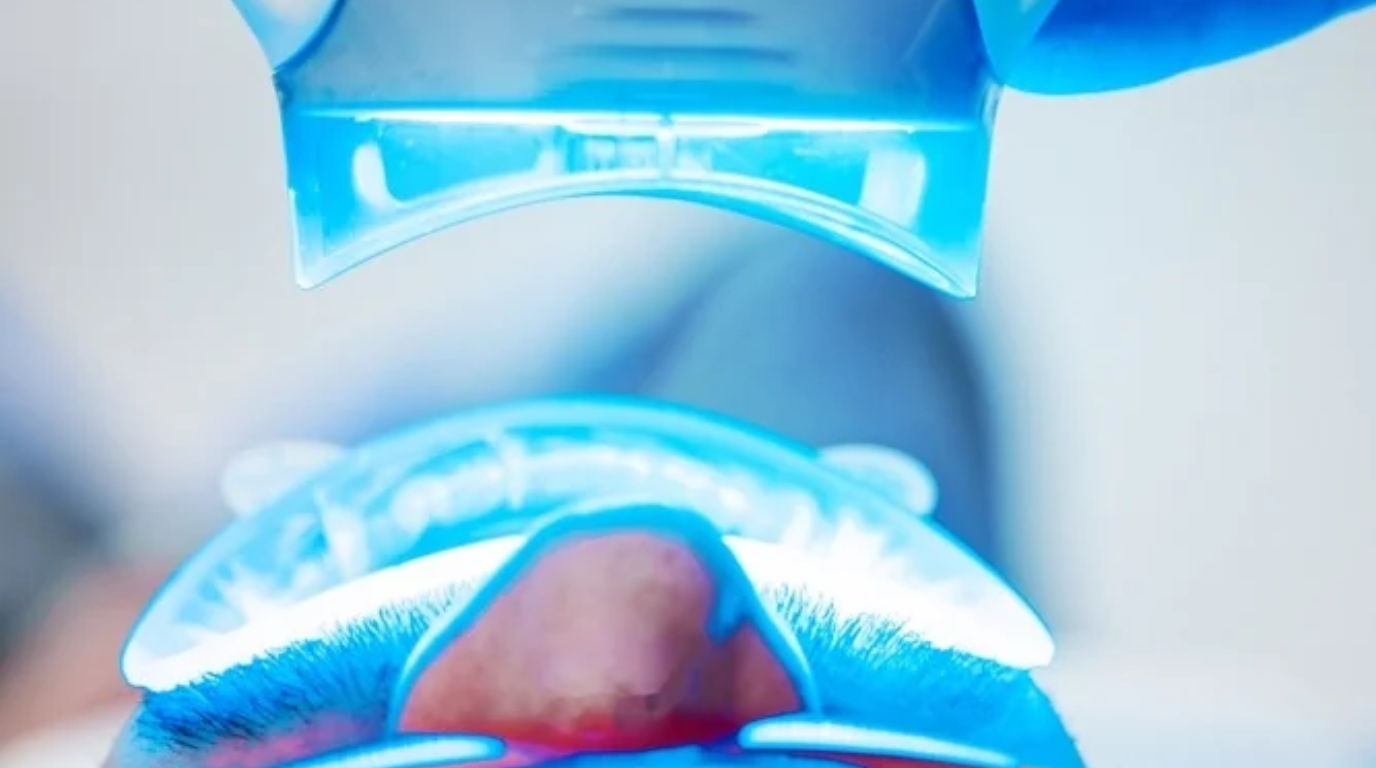
There is one fact about teeth whitening that determines almost everything else, and it is rarely mentioned before somebody starts. Whitening gel lightens natural tooth structure. It does nothing whatsoever to porcelain, to composite or to any other restorative material.
That sounds like a technicality. It is not. It is the reason the order of treatment matters, the reason some people finish whitening and find one tooth now looks wrong, and the reason a good cosmetic plan starts by working out where the existing work is.
What the Gel Is Actually Doing
Tooth staining comes in two forms. Extrinsic stain sits on the outside of the enamel, deposited by coffee, tea, red wine and tobacco, and much of it is removed physically during a professional clean. That is why teeth often look noticeably brighter after a scale and polish without any whitening at all.
Intrinsic colour is different. It is the colour of the tooth itself, held within the enamel and the dentine beneath it, and no amount of polishing touches it. This is where whitening operates.
For general guidance, the Australian Dental Association is a reliable source.
The active agent in a whitening gel breaks down and releases oxygen, which passes into the porous structure of the enamel and reacts with the pigmented molecules held there, breaking them into smaller, less coloured fragments. The tooth is not coated or painted. Its internal pigments are chemically altered, which is why the change is genuine and why it lasts.
Why Restorations Do Not Respond
That mechanism depends entirely on the material being porous, pigmented natural tooth. Restorative materials are neither, and so the gel simply has nothing to work on.
| Surface | Response to whitening gel |
|---|---|
| Natural enamel and dentine | Lightens as internal pigment is broken down |
| Porcelain crowns | No change at all |
| Porcelain veneers | No change at all |
| Composite fillings | No change at all |
| Bridges | No change at all |
| Surface stain on any of the above | Comes off with a professional clean |
The consequence follows immediately. If a front tooth carries a crown or a composite filling that was shaded to match the teeth around it, and those surrounding teeth are then whitened, the restoration stays exactly the colour it always was while everything around it moves.
A restoration that was invisible becomes visible, and nothing has gone wrong. The gel did precisely what it was supposed to do. It simply could not do it to the porcelain, and that is a matter of chemistry rather than of technique.
Which Is Why Sequence Matters
This is the practical heart of it, and it turns a potential disappointment into a straightforward piece of planning.
Whitening is done first. The natural teeth are lightened to the shade you actually want, and then they are given time to stabilise, because the colour settles slightly in the days after treatment and the final shade is not the shade on the day.
Only then is any new restoration matched. A crown, a veneer or a composite filling on a front tooth is shaded to the teeth as they now are, so it disappears against them and stays that way. Doing it in the other order means matching new work to a colour you are about to change.
Where existing restorations are already in place on visible teeth, that is a conversation worth having before whitening starts rather than afterwards, because it may mean planning to replace or refinish them once the whitening is complete. Knowing this in advance is what makes the outcome predictable.
What Professional Whitening Offers
Professional whitening treatments use higher-concentration agents than the products sold over the counter, which is what produces a noticeable change in a shorter time. That concentration is also precisely why they are supervised.
The assessment beforehand is the part that does the real work. It establishes whether the discolouration will actually respond, because not all of it will: staining from certain causes behaves differently, and a tooth that has darkened after trauma or root canal treatment is a distinct situation with its own approach.
It also checks that the teeth and gums are healthy enough to proceed, since whitening an untreated cavity or applying gel to inflamed gums is not a good idea. A check-up and clean before whitening removes the surface staining first, which sometimes means less whitening is needed than expected.
Sensitivity during whitening is common, usually temporary, and manageable, and it is one of the things a supervised approach is designed to handle. Being told what to expect, and what to do if it happens, is a considerable part of the value.
Planning Teeth Whitening in Marsden Park
Whitening is one of the simplest cosmetic treatments available, and it becomes far more satisfying when the plan accounts for the work already in the mouth.
For anyone considering teeth whitening in Marsden Park and nearby suburbs such as Riverstone, Parklea and Blacktown, an assessment establishes what will respond, what will not, and the order the work should happen in.
From there, the dental team can talk through what is realistic for your teeth, with no pressure.
The Takeaway
Whitening gel releases oxygen that passes into the porous structure of enamel and breaks down the pigmented molecules held inside it, so the change is genuine rather than a coating. That mechanism needs porous, pigmented natural tooth to work on, which is why porcelain crowns, veneers, bridges and composite fillings do not lighten at all. A restoration shaded to match the teeth around it will therefore stand out once those teeth are whitened, and nothing will have gone wrong. The answer is sequence: whiten first, let the shade settle, and match any new restoration to the teeth as they then are. Surface staining, meanwhile, largely comes off with a professional clean. The team at M&M Dental Care is happy to explain, with no pressure.
Frequently Asked Questions
Does teeth whitening work on crowns or veneers?
No. Whitening gel works by releasing oxygen into the porous structure of natural enamel, where it breaks down the pigment molecules held inside. Porcelain and composite are not porous, pigmented tooth structure, so they do not lighten at all. Surface stain on them can be removed with a professional clean, but their underlying colour will not change.
Should I whiten before or after getting a crown?
Before. Whitening lightens natural teeth and cannot change a restoration, so a crown should be shaded to the teeth as they will be, not as they are now. The usual sequence is to whiten, allow the shade to settle over the following days, and then match the new restoration to the final result.
How does professional teeth whitening actually work?
The active agent in the gel breaks down and releases oxygen, which passes into the porous enamel and reacts with the pigmented molecules held within the tooth, breaking them into smaller and less coloured fragments. The tooth is not painted or coated; its internal pigment is chemically altered, which is why the change lasts.
Why do my teeth look brighter after a dental clean?
Because much of the discolouration people notice is extrinsic stain sitting on the outside of the enamel, deposited by coffee, tea, red wine and tobacco. That is removed physically during a professional clean and polish, which is why teeth often look noticeably brighter afterwards without any whitening having been done.
Is sensitivity normal during whitening?
Some sensitivity during or shortly after whitening is common and usually temporary. It is one of the reasons professional whitening is supervised: the assessment beforehand checks that the teeth and gums are healthy enough to proceed, and you are told in advance what to expect and how to manage it if it occurs.
This blog is intended for general informational purposes only and does not constitute medical or dental advice. Every patient’s oral health needs are unique. Please consult a qualified dental practitioner for advice specific to your situation. M&M Dental Care encourages all patients to seek a professional assessment before commencing any dental treatment.