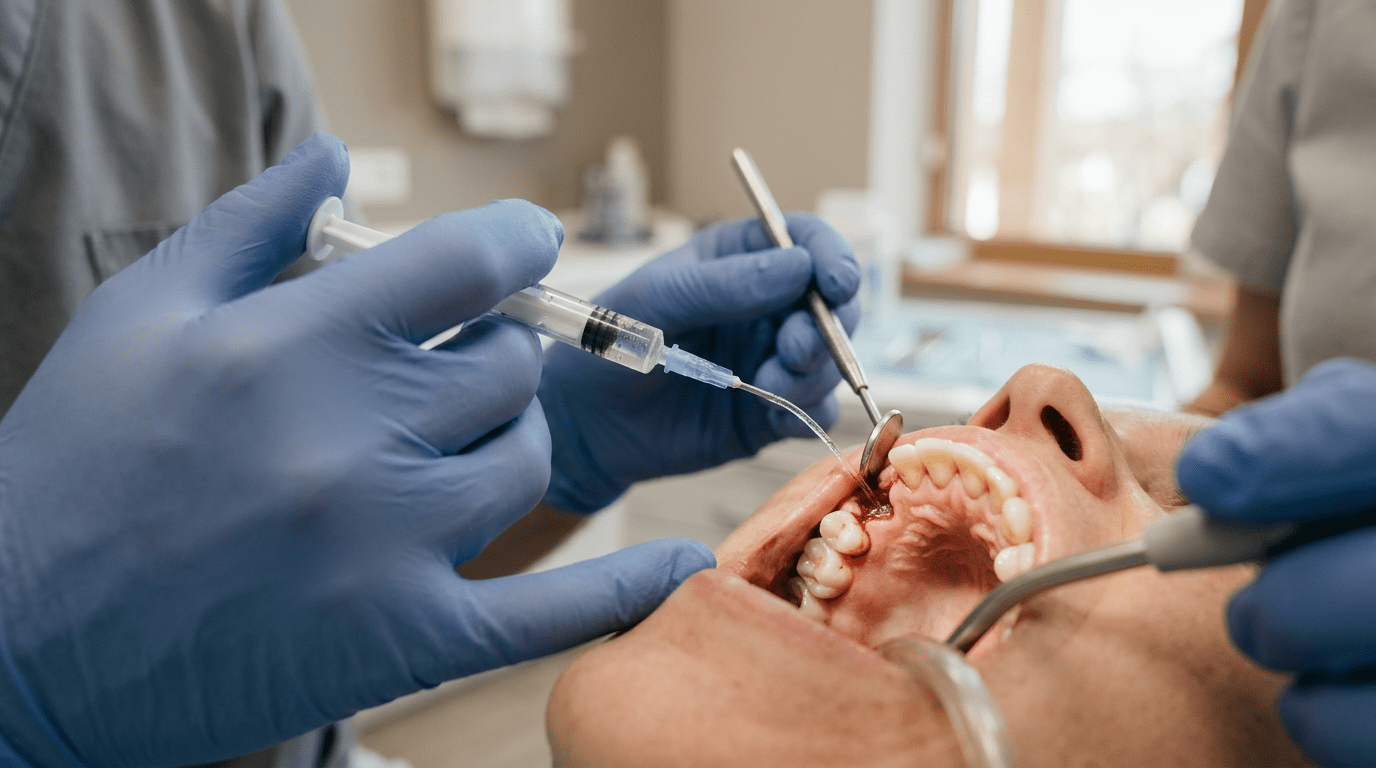
Dry Socket Treatment in Marsden Park
Dry socket is the most common complication of a tooth extraction, and it is the reason so many people come back to the dentist on day 3 after a wisdom tooth removal with a particular kind of pain they did not expect. At our Dentist Marsden Park practice, MM Dental treats dry socket under our emergency dentistry service for patients across Marsden Park, St Marys, Schofields and the surrounding northwest Sydney suburbs. This page covers what dry socket actually is, how to recognise it, what to do at home, how the dentist treats it, and the few things that genuinely reduce the risk.
The good news: dry socket is painful but not dangerous, it responds well to treatment, and it heals on its own within 7-10 days. The bad news: until it heals, it hurts in a way that ordinary painkillers do not touch.
What is dry socket, exactly?
Dry socket (alveolar osteitis) is the loss or dissolution of the blood clot that normally forms in an extraction socket, leaving the underlying bone exposed to the oral environment. The bone, no longer protected by the clot, becomes inflamed. The result is a distinctive deep, throbbing pain that typically starts 2-4 days after the extraction. The Better Health Channel and the Australian Dental Association both describe this as the most common post-extraction complication.
The incidence is worth knowing:
- Routine (non-surgical) extractions — 2-5% of cases
- Surgical lower wisdom tooth removals — up to 30% of cases
- Upper wisdom teeth, simple extractions — much lower
- Repeat dry socket after a previous dry socket — roughly 3x baseline risk
The risk is highest for lower wisdom teeth specifically because of the rich blood supply in the lower jaw and the chewing forces transmitted to the area. The bone at the back of the lower jaw is also denser, which makes clot stability marginal in the first 48 hours.
How do I know if I have dry socket?
The defining symptoms are severe throbbing pain that starts 2-4 days after an extraction, pain that radiates to the ear or temple, a visible empty-looking socket (no dark clot), and a foul taste or smell from the area. Ordinary pain relief that worked on day 1-2 stops working. Better Health Channel and the ADA’s post-extraction guidance use a very similar list of diagnostic features.
The symptom picture, in order of how often each appears:
- Severe throbbing pain starting day 2-4 — the most common first sign. Often radiates up to the ear, across the cheek, or down into the neck. Distinguishes it from normal post-op discomfort, which is worst on day 1 and improves steadily.
- Pain not relieved by ibuprofen or paracetamol — ordinary post-op pain responds. Dry socket pain does not, or only briefly.
- Empty-looking socket — instead of a dark red clot, the socket looks whitish at the bottom (the exposed bone) or empty. The gum around the socket may look inflamed but the socket itself is the giveaway.
- Foul taste or smell — the exposed bone and the food debris that gets into the socket produce a distinctive unpleasant taste, often reported as a constant bad taste rather than an intermittent one.
- Low-grade fever in some cases — not always present, but a possible feature. If fever is high or rapidly rising, the picture may be infection rather than dry socket — the dentist distinguishes them at the appointment.
The practical self-check: if the pain was improving and then suddenly got worse on day 3-4, with a foul taste and ordinary painkillers not helping, dry socket is the most likely diagnosis. Book in within 24 hours.
What should I do at home before seeing the dentist?
Rinse gently with warm salty water, take ibuprofen + paracetamol as directed, and avoid smoking, straws, or anything that creates suction in the mouth — but book in for a same-day appointment because the pain will not resolve without the dentist placing a medicated dressing. Home care is for comfort while you are waiting to be seen, not a substitute for the appointment.
Things that help at home:
- Warm salt-water rinses — half a teaspoon of salt in a glass of warm water, held gently over the socket for 30 seconds, twice a day. Do not swish vigorously — the goal is to keep the area clean, not to disturb what little clot remains.
- Ibuprofen + paracetamol — the combination works better than either alone for dental pain. Standard adult dose is 400 mg ibuprofen + 500 mg paracetamol every 6 hours, unless your GP has advised otherwise. Stagger them 2-3 hours apart if the pain is particularly bad.
- Cold compress on the outside of the cheek — 20 minutes on, 20 minutes off. Reduces the throbbing and the inflammation.
- Sleep propped up — two pillows. Reduces the blood pooling around the site overnight.
- Soft food on the opposite side — yoghurt, scrambled eggs, smoothies (without a straw).
Things to avoid:
- Smoking — the suction dislodges the clot, and the chemicals delay healing. Critical in the first 72 hours.
- Straws — same suction issue.
- Spitting, vigorous rinsing, poking with the tongue or finger — all disturb the site.
- Hot food or drink — the heat can dissolve a marginal clot.
- Aspirin for pain relief — aspirin is a blood thinner and can prolong the issue. Stick to ibuprofen.
How is dry socket treated at the dentist?
The dentist gently irrigates the socket with saline, places a medicated dressing (usually iodoform-based paste on a gauze strip) into the socket, and reviews the patient every 1-2 days until symptoms resolve. Pain relief is typically dramatic within 30-60 minutes of the dressing being placed. The Better Health Channel describes this as the standard of care in Australia.
The appointment itself, step by step:
- Diagnosis — visual inspection of the socket, often with a radiograph to rule out retained root fragment or other cause. The diagnosis is usually clear from the symptoms and the socket appearance.
- Gentle irrigation — the socket is flushed with warm saline to remove food debris and any necrotic clot. This is not a painful procedure.
- Medicated dressing — a small strip of gauze soaked in iodoform-based paste (or a similar medicament) is placed gently into the socket. The dressing soothes the exposed bone and reduces the bacterial load.
- Local anaesthetic if needed — most patients do not need numbing, but it is available if the irrigation is sensitive.
- Pain relief script if needed — for severe cases, a short course of stronger pain relief is appropriate.
- Review in 1-2 days — the dressing is checked, changed if needed, and the patient is reassessed. Most cases need 1-3 dressing changes before the pain resolves.
- Resolution — the pain typically resolves within 24-48 hours of the first dressing. The socket heals underneath the dressing over the next 7-10 days. A follow-up X-ray is not normally required.
The important thing the dentist does NOT do: disturb the socket more than necessary. Dry socket treatment is about soothing the bone, not aggressively cleaning the area. Less is more.
How can dry socket be prevented?
The two most important prevention steps are to avoid smoking for at least 72 hours after the extraction and to follow the post-op instructions for rinses, diet, and avoiding straws. Beyond that, oral contraceptive use, a history of previous dry socket, and the difficulty of the extraction are the main risk factors. The Better Health Channel and the ADA’s post-op guidance are the standard patient references.
What actually moves the risk:
- Smoking — the single biggest modifiable risk factor. The suction dislodges the clot, and the chemicals (nicotine, carbon monoxide) delay healing. Stopping for 72 hours around an extraction is the single most useful thing a smoker can do.
- Oral contraceptive use — a small but real increase in risk, mediated by oestrogen’s effect on clot stability. Worth mentioning to the dentist before the extraction. Scheduling extractions outside the active pill days can reduce the risk slightly.
- Previous dry socket — the risk roughly triples. The dentist will be more cautious with post-op instructions and may schedule a 24-hour check.
- Surgical lower wisdom teeth — the highest-risk category. The dentist will use a combination of in-socket antibiotics, primary closure with sutures, and careful post-op instructions to reduce the risk.
- Poor oral hygiene — rinsing too aggressively in the first 24 hours, or not at all afterwards, both increase the risk. The right balance is to leave the area alone for the first 24 hours, then start gentle salt-water rinses.
Things that don’t help despite being widely recommended: mouthwash on day 1 (too aggressive), herbal remedies (no evidence), and skipping pain relief (the pain cycle is harder to break once it starts).
Frequently asked questions (supplementary)
Is dry socket an infection? No. It is the absence of a protective clot, not a bacterial infection. Antibiotics are not usually prescribed. Anti-inflammatories and the medicated dressing are the main treatments.
How long does dry socket last? Pain usually resolves within 24-48 hours of the first dressing. The socket itself heals over 7-10 days. The dentist sees the patient every 1-2 days during that window.
Can I get dry socket from a routine filling? No. Dry socket is specific to extractions, where a socket is left behind. Fillings, crowns, root canals — none of these have a socket and none can develop dry socket.
Will it happen again with my next extraction? Possibly. The risk roughly triples if you have had dry socket before. The dentist accounts for this with closer post-op follow-up.
Can I use a straw after day 3? Most post-op instructions allow straws and gentle rinsing from day 3 onwards. The critical period is the first 48-72 hours.
Ready to start?
If a tooth extraction site started hurting again on day 2-4 and ordinary pain relief is not touching it, our Dentist Marsden Park practice can usually see you the same day. Treatment is straightforward, the relief is fast, and the case resolves within a week. We regularly see patients from neighbouring St Marys and the wider northwest Sydney corridor. Book online or call our practice, or follow up directly with the wisdom tooth removal service if your extraction was recent.