
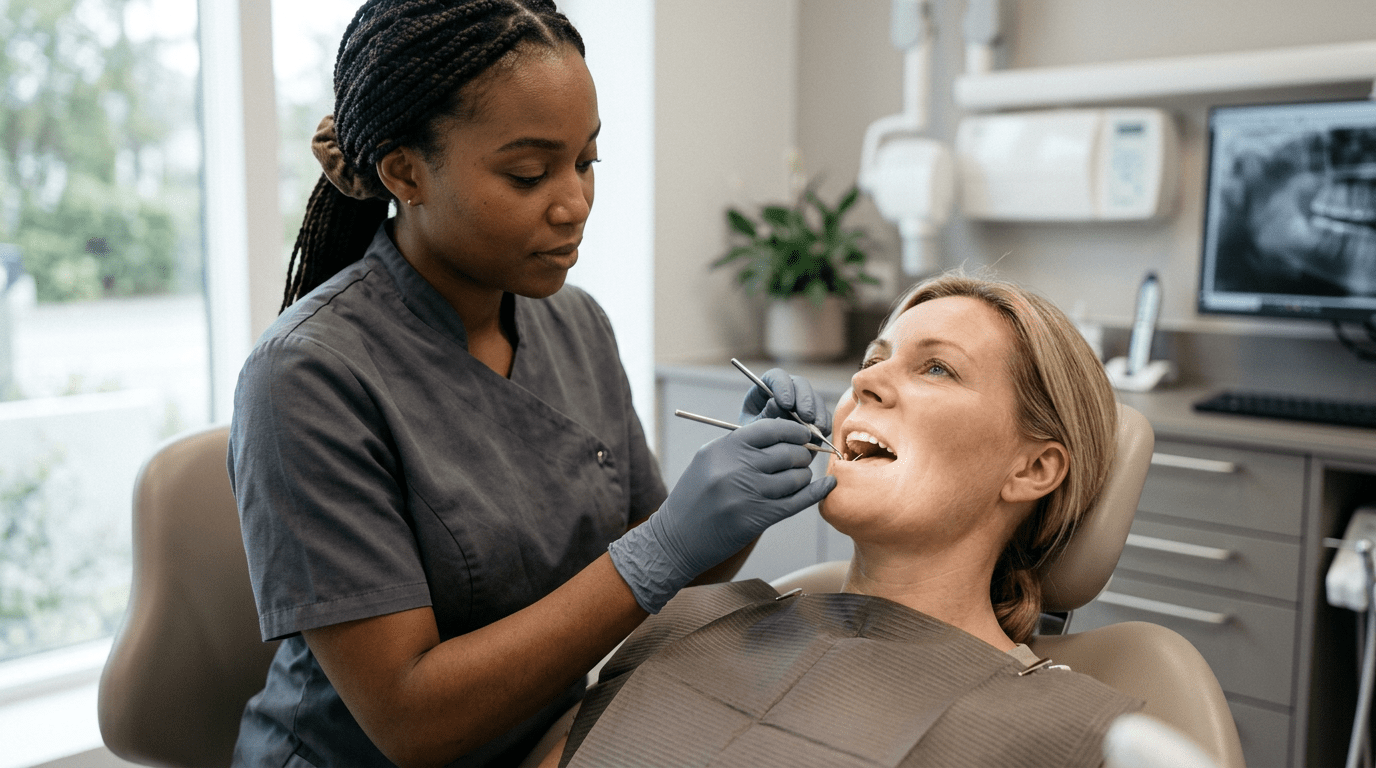
Loose Adult Tooth Treatment in Marsden Park
A loose adult tooth is a genuinely worrying symptom. By the time a tooth is noticeably mobile to the patient, the underlying problem has usually been developing for a while. At our Dentist Marsden Park practice, MM Dental diagnoses and manages loose teeth as part of our emergency dentistry service for patients across Marsden Park, St Marys, Schofields and the wider northwest Sydney corridor. This page covers the common causes, why prompt assessment matters, what can be done to save the tooth, and the treatment options.
The honest opening: a loose adult tooth is not normal and is not something to wait out. The right next step is a same-week appointment. The earlier the cause is identified, the better the chance of keeping the tooth.
What causes a loose tooth in an adult?
The three main causes of a loose tooth in an adult are advanced periodontal (gum) disease, dental trauma, and occlusal trauma (a heavy bite or chronic grinding). Less common causes include root fracture, infection, and certain medications. The Australian Dental Association and Better Health Channel’s gum disease page describe the main causes.
The three main causes, ranked by frequency:
- Advanced periodontal disease — the most common cause in adults. The bone that supports the tooth has been lost to gum disease, and the remaining bone is not enough to hold the tooth firmly. Often the patient has not noticed the gum disease progressing because it is usually painless until the late stages.
- Dental trauma — a recent knock, fall, or sports injury can dislodge a tooth from its socket. The tooth may be partially displaced, fractured at the root, or simply loosened. Time is critical for re-implantation if the tooth has come out.
- Occlusal trauma — a heavy bite, a tooth that hits first when the patient closes, or chronic grinding (bruxism) can put excessive force on a tooth and its supporting structures. The tooth may become mobile without any bone loss, and the mobility can resolve if the bite is corrected.
- Root fracture — a vertical crack in the root of the tooth. Often difficult to diagnose without a CBCT scan. Usually requires extraction, as the fracture cannot be reliably repaired.
- Infection — a periapical abscess from a dead nerve can destroy the bone around the root tip, leading to mobility. The infection has to be treated (usually with a root canal) and the bone allowed to heal.
- Medications — some medications (bisphosphonates, denosumab) can affect bone healing. Particularly relevant for patients on long-term osteoporosis treatment.
The honest framing: identifying the cause is the first thing. The treatment for a loose tooth from gum disease is very different from the treatment for a loose tooth from a heavy bite. The diagnosis drives the case.
How is a loose tooth assessed?
A loose tooth is assessed through clinical examination (mobility grading, periodontal probing, percussion testing), X-rays (periapical and sometimes CBCT), and a review of the patient’s medical and dental history. The ADA’s emergency dentistry guidance and standard periodontal texts cover the assessment protocol.
The clinical assessment:
- Mobility grading — the tooth is moved gently with two instrument handles. Grade I is movement up to 1mm horizontally. Grade II is movement more than 1mm horizontally. Grade III is movement both horizontally and vertically (the tooth can be depressed into the socket or lifted out). Grade III is the most severe and the hardest to treat.
- Periodontal probing — pocket depths around the tooth. Deep pockets with bleeding indicate periodontal disease. The pattern of bone loss on the X-ray confirms the diagnosis.
- Percussion testing — tapping the tooth gently. A dull sound suggests a dead nerve or a periapical infection. A high, metallic sound suggests ankylosis (the tooth is fused to the bone).
- Vitality testing — cold test or electric pulp test. A non-responsive tooth suggests a dead nerve, which may be the cause of a periapical infection.
- X-rays — periapical X-ray to assess the bone level and look for periapical radiolucencies. CBCT in selected cases for vertical root fracture assessment.
- Bite check — articulating paper to mark the contacts. A heavy or premature contact contributes to mobility.
The honest framing: the assessment is not optional. A loose tooth with a healthy mouth, a vital nerve, and no bone loss is a different problem from a loose tooth with deep pockets, bone loss, and a non-vital nerve. The treatment depends on the diagnosis.
Can a loose tooth be saved?
A loose tooth can sometimes be saved, depending on the cause and the severity. Mobility from a recent trauma is often reversible once the tooth is stabilised. Mobility from advanced periodontal disease may not be reversible if the bone loss is severe. The ADA’s position on tooth mobility and standard periodontal texts cover the prognosis assessment.
The prognosis by cause:
- Trauma (recent) — good prognosis. The tooth is splinted to the adjacent teeth for 1-2 weeks, the supporting structures heal, and the mobility resolves. Success rate is high if treated within the first few weeks.
- Occlusal trauma — good to excellent prognosis. The bite is adjusted, a night guard is fitted, and the supporting structures heal. The mobility may take 3-6 months to resolve.
- Periodontal disease (early) — fair to good prognosis. The gum disease is treated, the patient maintains, and the mobility stabilises. The lost bone does not regenerate, but the remaining bone is enough to hold the tooth.
- Periodontal disease (advanced) — poor prognosis. The bone loss is severe, and the tooth has lost too much support. Extraction and replacement is often the better answer.
- Vertical root fracture — poor prognosis. The fracture cannot be reliably repaired. Extraction is the only durable answer.
The honest framing: the prognosis is case-specific. A Grade I mobile tooth from occlusal trauma has an excellent prognosis. A Grade III mobile tooth from advanced periodontal disease has a poor prognosis. The dentist will tell you the case-specific prognosis based on the assessment.
How is a loose tooth treated?
A loose tooth is treated by addressing the cause, stabilising the tooth, and managing the underlying condition. The treatment plan depends on the cause. The ADA’s emergency dentistry guidance and the Better Health Channel’s teeth-grinding page are the standard references.
The treatment by cause:
- Trauma — splinting to adjacent teeth for 1-2 weeks using a flexible wire-composite splint. Soft diet during the healing phase. Vitality testing at 1 month, 3 months, 6 months, and 12 months to monitor for pulp necrosis. Endodontic treatment if the nerve dies.
- Occlusal trauma — bite adjustment to remove the heavy contact, night guard to protect the teeth during sleep, monitoring of the mobility over 3-6 months. The mobility usually resolves if the cause is addressed.
- Periodontal disease (early) — non-surgical periodontal therapy (deep cleaning), oral hygiene instruction, 3-monthly maintenance. The mobility stabilises as the inflammation is controlled.
- Periodontal disease (advanced) — specialist referral. Surgical or regenerative procedures may be attempted, but extraction is often the better answer. The replacement options are an implant, a bridge, or a partial denture.
- Vertical root fracture — extraction. The fractured root cannot be reliably saved.
- Infection (periapical abscess) — root canal treatment to remove the dead nerve and the infection, plus a crown to protect the tooth. The mobility resolves as the bone heals.
The honest framing: the treatment is not just about the loose tooth. It is about addressing the cause, which often involves other teeth, the bite, the gums, or the patient’s overall health. A tooth that becomes loose because of a heavy bite will not stay stable until the bite is fixed.
What if the tooth cannot be saved?
A tooth that cannot be saved is extracted, and the patient has three main replacement options: a dental implant, a bridge, or a removable partial denture. The choice depends on the location of the tooth, the condition of the neighbouring teeth, the patient’s budget, and the patient’s preference. The ADA’s position on tooth replacement is that the replacement should be planned in conjunction with the extraction, not as an afterthought.
The three replacement options:
- Dental implant — a titanium post placed in the bone, with a crown on top. The gold standard for single-tooth replacement. Preserves the bone, does not affect neighbouring teeth, lasts 15-25+ years. Higher cost ($4,000-$6,500) but the longest-lasting answer.
- Bridge — a crown on each neighbouring tooth, with a false tooth in between. Less expensive than an implant ($3,000-$5,000), but requires drilling the neighbouring teeth. Lasts 10-15 years.
- Removable partial denture — a plastic or metal-and-acrylic plate that replaces one or more teeth. The lowest-cost option ($1,000-$2,000), but the least comfortable and the least stable. Lasts 5-8 years.
The honest framing: not every missing tooth needs to be replaced. A missing back tooth that does not affect the bite or the smile can often be left unreplaced. A missing front tooth usually does need replacement for cosmetic and functional reasons. The dentist will advise based on the case.
Frequently asked questions (supplementary)
Is a loose adult tooth an emergency? It depends on the cause. A loose tooth from a recent injury is an emergency; call the practice for a same-day appointment. A loose tooth that has been progressively worsening is urgent but not emergent; call for a same-week appointment.
Can a loose tooth tighten back up on its own? Sometimes, particularly if the cause is occlusal trauma and the bite is corrected. Loose teeth from periodontal disease do not tighten back up on their own; the underlying disease has to be treated.
Can a loose tooth be splinted? Yes, a flexible wire-composite splint can stabilise a mobile tooth to the adjacent teeth while the supporting structures heal. Splinting is most useful for trauma-related mobility.
Will I lose the tooth? It depends on the cause and the severity. The dentist will give you a case-specific prognosis after the assessment.
How do I brush a loose tooth? Gently, with a soft brush, and avoid the mobile area if it is painful. The hygienist can show you modified brushing and flossing techniques for mobile teeth.
Can a night guard help? Yes, if the cause is grinding or clenching. A night guard distributes the bite forces and protects the teeth (and any restorations) from further damage.
Ready to start?
If you have a loose adult tooth, a same-week appointment at our Dentist Marsden Park practice is the right next step. We will examine the tooth, take an X-ray, identify the cause, and give you an honest answer about whether the tooth can be saved and what the treatment involves. For acute pain or a tooth that has just been knocked out, our emergency dentistry service handles same-day cases. For loose teeth that have been progressively worsening, a routine appointment at the check-up is the right place to start. We regularly see patients from neighbouring St Marys and across the wider northwest Sydney corridor. Book online or call our practice.


