
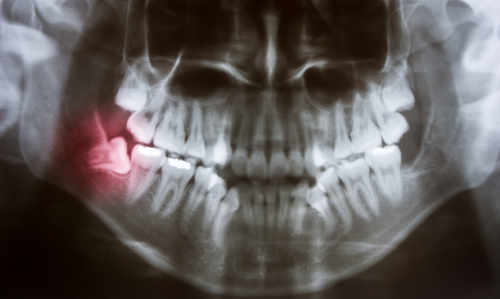
Wisdom teeth arrive last, usually somewhere between seventeen and twenty-five, and they arrive into a mouth that finished making room for itself years earlier. That is the whole of the problem in a sentence.
What is less widely understood is why wisdom teeth removal is so often raised in the late teens and early twenties, well before anything has actually gone wrong. It is not impatience. There are three biological reasons, and they all point the same way.
The Room Ran Out Some Time Ago
The human jaw has been getting smaller over evolutionary time while the number of teeth has stayed the same, and the third molars are the ones left standing when the music stops. Some people have ample room for them, some have none, and there is no way to know which category you are in by looking.
When there is not enough space, the tooth does not simply stop. It comes as far as it can and then wedges, which is what impaction means. It might tilt forward against the molar in front, lie down horizontally, or remain buried in the bone entirely.
A general overview is available from health authorities such as healthdirect.
A partially erupted wisdom tooth is the version that causes the most trouble, because it creates a flap of gum over a tooth that cannot be cleaned properly. Food and bacteria collect underneath, the gum becomes inflamed, and the whole area is genuinely difficult to keep healthy no matter how conscientious you are.
The Three Reasons Age Matters
This is the part that explains the timing, and it is rarely spelled out. Three separate things change between twenty and forty, and none of them change in your favour.
| What changes with age | Why it matters |
| Roots are still forming | Shorter roots are simpler to remove |
| Bone is more elastic | It yields rather than resisting |
| Roots move closer to the nerve | Proximity increases with development |
| Healing capacity is higher | Recovery is quicker when younger |
| Fewer other commitments | Downtime is easier to arrange |
| Damage has not yet occurred | The neighbouring molar is still sound |
The root point is the most important and the least known. In the late teens the roots of a wisdom tooth are typically still developing and have not reached their full length, and a tooth with shorter, less established roots is a more straightforward proposition than the same tooth two decades later.
Bone changes too. Younger bone is more pliable and gives a little, whereas mature bone is denser and less forgiving. Combined with a younger body’s capacity to heal, that is why recovery in the early twenties is generally quicker and more predictable than the same procedure performed much later.
The Tooth Next Door
There is a second molar sitting immediately in front of every wisdom tooth, and it is a perfectly good tooth with a long career ahead of it. It is also the tooth an impacted wisdom tooth pushes against.
Where a wisdom tooth is tilted forward, its crown presses into the back of that second molar at a point which cannot be brushed and cannot be seen. Decay can develop there on the second molar itself, and it is decay on a tooth that has done nothing wrong.
The same contact point makes gum problems more likely in a place where the gum is hard to clean and hard to treat. This is why an assessment considers the neighbour as much as the wisdom tooth: the question is not only what the third molar is doing, but what it is doing to the tooth it is leaning on.
That is a genuinely persuasive argument for looking early. A second molar lost to decay caused by the tooth behind it is a considerable loss, and it is entirely avoidable if the situation is seen in time.
Not Every Wisdom Tooth Needs to Go
It is worth saying plainly that removal is not automatic. Plenty of people have wisdom teeth that erupt fully, sit in a sensible position, meet an opposing tooth and can be cleaned like any other molar. Those teeth are simply teeth, and they are left alone to get on with it.
What an assessment establishes is which situation you are actually in, and that requires an X-ray, because almost everything that matters is happening below the gum. The angle of the tooth, the shape and length of the roots, the position of the nerve and the state of the second molar are all invisible from above.
Where removal is appropriate, wisdom tooth extraction is planned around what the imaging shows rather than around a general rule, and the plan is explained beforehand so you know what is involved. Where it is not appropriate, monitoring is a perfectly legitimate answer.
The point of looking in the late teens is not to make a decision quickly. It is to make it deliberately, while every option is still open and while the biology is on your side.
Assessing Wisdom Teeth in Marsden Park
Wisdom teeth are one of the few things in dentistry where the calendar genuinely matters, and the window is wider than people think but not infinite.
For anyone considering wisdom teeth removal in Marsden Park and nearby suburbs such as Riverstone, Parklea and Blacktown, an assessment with imaging shows the angle, the roots and the effect on the tooth in front.
From there, the dental team can explain what they can see and whether anything needs doing at all, with no pressure.
The Takeaway
Wisdom teeth erupt last, into a jaw that finished making room years earlier, and when there is not enough space they wedge rather than stopping. The reason removal is so often raised in the late teens and early twenties is biological rather than administrative. The roots are typically still forming and have not reached full length, younger bone is more pliable and yields rather than resisting, and healing capacity is higher, so recovery tends to be quicker and more predictable. There is also the second molar sitting immediately in front, which an angled wisdom tooth presses into at a point that cannot be brushed or seen. Not every wisdom tooth needs removing, and an X-ray is what establishes which situation you are in. The team at M&M Dental Care is happy to take a look, with no pressure.
Frequently Asked Questions
What is the right age for wisdom teeth removal?
There is no single age, but the late teens and early twenties are commonly discussed for biological reasons. The roots are typically still developing and have not reached full length, younger bone is more pliable, and healing capacity is higher, so recovery tends to be quicker and more predictable than the same procedure performed decades later.
What does an impacted wisdom tooth mean?
It means the tooth has come as far as it can and then wedged, because there is not enough room for it. It may tilt forward against the molar in front, lie horizontally, or remain buried in the bone. A partially erupted wisdom tooth creates a flap of gum that is genuinely difficult to keep clean.
Do all wisdom teeth need to be removed?
No. Plenty of people have wisdom teeth that erupt fully, sit in a sensible position, meet an opposing tooth and can be cleaned like any other molar, and those are left alone. An assessment with an X-ray is what establishes which situation applies, since almost everything that matters is happening below the gum.
Can a wisdom tooth damage the tooth in front of it?
It can. Where a wisdom tooth is tilted forward, its crown presses against the back of the second molar at a point that cannot be brushed or seen, and decay can develop on that second molar. That is one of the more persuasive reasons for assessing wisdom teeth before problems appear.
Why is an X-ray needed for wisdom teeth?
Because the important details are all below the gum. The angle of the tooth, the shape and length of the roots, the proximity of the nerve and the condition of the second molar cannot be judged by looking. Imaging is what allows the decision, and any procedure, to be planned around your actual anatomy.
This blog is intended for general informational purposes only and does not constitute medical or dental advice. Every patient’s oral health needs are unique. Please consult a qualified dental practitioner for advice specific to your situation. M&M Dental Care encourages all patients to seek a professional assessment before commencing any dental treatment.
