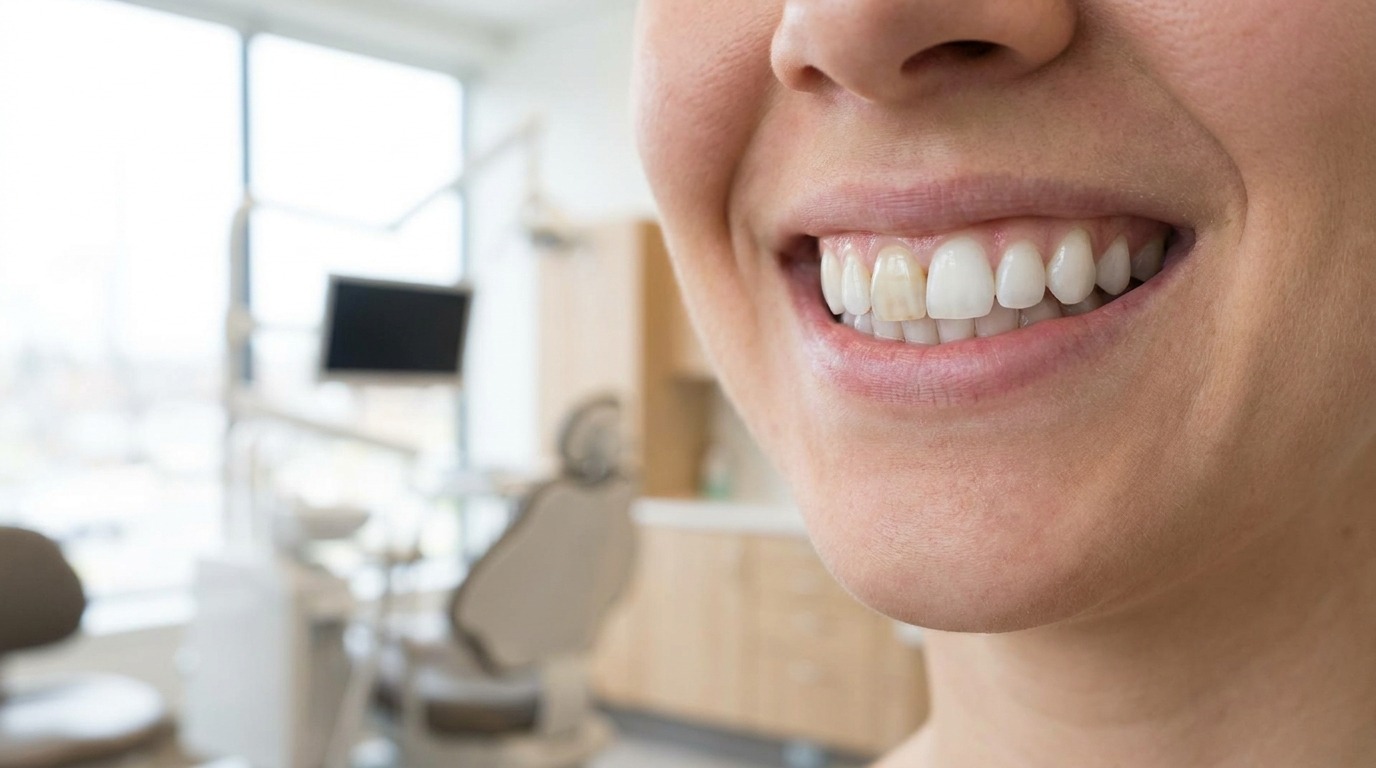
Discoloured Tooth After Trauma in Marsden Park
A tooth that goes dark after a knock, fall, or sports injury is a common presentation at our Dentist Marsden Park practice. It is alarming to look at, but the cause is usually straightforward and the treatment options are well established. MM Dental manages dental trauma as part of our emergency dentistry service for patients across Marsden Park, St Marys, Schofields and the wider northwest Sydney corridor. This page covers what the dark colour means, when the tooth can be saved, the treatment options, and the realistic outcome.
The honest opening: a dark tooth after trauma is not necessarily a dead tooth, but it is a sign that the nerve has been disturbed. The right next step is a check, an X-ray, and a vitality test, not a guess.
What does it mean when a tooth goes dark after trauma?
A dark tooth after trauma usually means the nerve inside the tooth has been damaged, and the breakdown products of the blood inside the tooth have stained the dentine from within. The colour change is not on the surface. It is inside the tooth. The Australian Dental Association and Better Health Channel’s dental injuries page describe the mechanism. The change happens because the blood vessels inside the tooth have ruptured, and the breakdown products (particularly haemosiderin) leach into the dentine.
The three colour changes that can follow trauma:
- Yellow/brown — usually appears within 1-2 weeks. Often indicates reversible pulpitis (the nerve is inflamed but not dead). The tooth may return to its normal colour over weeks to months.
- Grey/dark grey — usually appears within 1-3 months. More concerning. Suggests the nerve is dying or has died. The colour is unlikely to resolve on its own.
- Pink — rare. Indicates internal resorption starting in the dentine. Needs immediate attention.
The honest framing: the colour alone does not tell the whole story. A tooth can go dark and still be alive, or stay light-coloured and still have a dead nerve. The diagnosis requires an X-ray and a vitality test (cold test or electric pulp test), not a colour assessment.
How is the tooth monitored after trauma?
A traumatised tooth is monitored for at least 1 year, with periodic vitality testing and radiographs, because pulp necrosis (the nerve dying) can develop months after the initial injury. The ADA’s position on dental trauma and Better Health Channel both emphasise the long monitoring window.
The standard monitoring schedule after dental trauma:
- Initial review — 1-2 weeks after the injury. Clinical exam, X-ray, vitality test. The baseline is established.
- 6-week review — second vitality test, X-ray if symptoms develop.
- 3-month review — most cases of pulp necrosis present within this window. Vitality test and X-ray.
- 6-month review — continued monitoring. The colour is often assessed and compared to the baseline.
- 12-month review — most cases of pulp necrosis will have presented by now. If the tooth is still vital and asymptomatic at 12 months, the long-term prognosis is good.
- Annual review for 3-5 years — late pulp necrosis and root resorption can develop years after the trauma. Continued monitoring is the standard.
The honest framing: a tooth that is fine at the 6-week review can still die at the 6-month review. The patient has to commit to the monitoring schedule, and any new symptoms (pain, swelling, bad taste, increasing darkening) need a same-day call.
What are the treatment options for a dark tooth?
The treatment options for a dark tooth depend on whether the nerve is still alive, whether the tooth is restorable, and what the patient wants cosmetically. The four main options are: monitor, internal bleaching, external whitening, or a veneer or crown. The ADA’s position on discoloured teeth and the Better Health Channel cover the options.
The four options:
- Monitor — appropriate for early yellow/brown discolouration where the vitality test is equivocal. The colour may resolve as the pulp recovers. Continued monitoring as described above.
- Internal (non-vital) bleaching — the standard treatment for a discoloured, root-canal-treated tooth. The dentist opens the back of the tooth, places a bleaching agent (sodium perborate or hydrogen peroxide) inside, and seals it for 1-2 weeks. The walking bleach technique. The colour lifts from the inside out. Often combined with external bleaching to match the surrounding teeth.
- External whitening — the standard take-home or in-chair whitening applied to the outside of all the teeth. Useful when the discoloured tooth is still vital (has a live nerve) and the colour difference is mild. The whitening evens out the shade across all the visible teeth.
- Veneer or crown — for cases where bleaching does not work, or the tooth has additional structural issues. A porcelain veneer covers the front of the tooth and matches the surrounding teeth. A crown is needed if the tooth has had a root canal and is structurally compromised.
The honest framing: internal bleaching is the most conservative option and works well for most dark, root-canal-treated anterior teeth. The bleaching may need to be repeated every few years as some relapse is common. Veneers and crowns are irreversible and only used when bleaching does not work.
When does a dark tooth need a root canal?
A dark tooth needs a root canal when the nerve has died (pulp necrosis), which is confirmed by a non-responsive vitality test, an X-ray showing a periapical radiolucency (a dark area at the tip of the root indicating infection), or symptoms of pain or swelling. The ADA’s endodontic guidance and the Better Health Channel’s dental injuries page cover the diagnostic criteria.
The clinical decision points:
- Vitality test positive (the nerve is alive) — no root canal. Monitor, manage the colour cosmetically.
- Vitality test negative, no symptoms, no periapical lesion — monitor for 3-6 months. Some teeth recover late; some progress to necrosis.
- Vitality test negative, periapical lesion on X-ray — root canal indicated. The infection is established.
- Vitality test negative, symptoms of pain or swelling — root canal urgently. The infection is active and spreading.
The honest framing: a root canal is a treatment for a dead or dying nerve, not a treatment for a dark colour. The colour is a symptom, not a diagnosis. The vitality test and the X-ray tell you whether the nerve needs to come out.
How can a darkened tooth be prevented in the first place?
A darkened tooth after trauma cannot be entirely prevented, but the severity of the discoloration is reduced by prompt treatment of the original injury and by protecting the tooth from further trauma during the healing phase. The ADA’s trauma prevention guidance and the Better Health Channel emphasise prevention.
What reduces the risk of darkening after trauma:
- Prompt treatment of the original injury — re-implantation of a knocked-out tooth within 30 minutes, splinting of a displaced tooth, prompt root canal of a tooth with a dead nerve. All reduce the inflammatory cascade that leads to darkening.
- Custom mouthguard for contact sport — the single most effective prevention. A custom mouthguard from the dentist is materially better than an off-the-shelf boil-and-bite.
- Avoiding further trauma during healing — soft food for 1-2 weeks, no biting on the traumatised tooth, careful brushing around the area.
- Prompt follow-up of any symptoms — pain, swelling, or increasing darkening after an injury needs a same-day call. The sooner the intervention, the better the long-term colour outcome.
The honest framing: not all darkening can be prevented. Some teeth go dark even with perfect management, because the nerve damage was severe at the time of injury. The goal is to minimise the darkening and treat it well when it does happen.
Frequently asked questions (supplementary)
How long after trauma does a tooth go dark? Yellow/brown discolouration often appears within 1-2 weeks. Grey discolouration typically appears within 1-3 months. Some teeth do not discolour for 6-12 months after the injury.
Can a dark tooth go back to normal? Sometimes, particularly in the early yellow/brown phase if the nerve is still alive. Grey discolouration is unlikely to resolve without intervention.
Does internal bleaching damage the tooth? Walking bleach is a well-established procedure with a good safety record when done correctly. The main risk is external cervical resorption, which is rare and usually related to the bleaching technique.
How long does internal bleaching last? Usually 1-5 years, with some relapse. Many teeth need a repeat bleaching every few years. A veneer or crown is a longer-term answer for cases that relapse quickly.
Is a dark tooth weaker than a normal tooth? A dark tooth is not necessarily weaker. The colour is a sign of internal change, not structural change. A root-canal-treated tooth, however, is drier and more brittle, and usually needs a crown to prevent fracture.
Can I whiten a dark tooth at home? External whitening will not significantly lighten a tooth that is dark from the inside. Internal bleaching is a dental procedure and cannot be done at home. If the colour is from external staining (coffee, tea, smoking), external whitening will help. If it is from internal trauma, internal bleaching is the answer.
Ready to start?
If you have a dark tooth after a recent or past injury, a 30-minute consultation at our Dentist Marsden Park practice is the right next step. We will test the vitality, take an X-ray, and give you an honest answer about the nerve status and the colour options. For a recent injury with a knocked-out or displaced tooth, our emergency dentistry service handles same-day cases. For older trauma, the cosmetic dentistry service covers the colour work. We regularly see patients from neighbouring St Marys and across the wider northwest Sydney corridor. Book online or call our practice.