
Impacted Wisdom Teeth in Marsden Park
Wisdom teeth that do not have room to come through cleanly cause more problems per tooth than almost any other dental issue we see at our Dentist Marsden Park practice. MM Dental provides wisdom tooth extraction under our emergency dentistry and oral-surgery service for patients across Marsden Park, St Marys, Schofields, Rouse Hill and the surrounding northwest Sydney suburbs. This page covers what impaction means, when an impacted wisdom tooth actually needs to come out, what the surgery involves, what recovery looks like, and the real risk picture.
The honest framing: most impacted wisdom teeth should come out, but not because of the reasons most people are told. The case is mostly about preventing future problems, not about fixing a current one.
What does it mean for a wisdom tooth to be impacted?
An impacted wisdom tooth is one that does not have enough room to erupt into a functional position in the jaw — it is trapped against the second molar, the jawbone, or the soft tissue. The Australian Dental Association and Better Health Channel both describe this as a common finding on a routine X-ray, particularly in young adults. Approximately 35-45% of people will have at least one impacted wisdom tooth over their lifetime.
The four main impaction patterns, ranked by how often we see them at our chair:
- Mesial impaction — the tooth is angled forward toward the second molar. The most common pattern. Often causes decay on the back of the second molar because the contact point is hard to clean.
- Vertical impaction — the tooth is pointing up correctly but has no room to come through the gum. Usually asymptomatic; sometimes managed by removing just the soft tissue cover.
- Horizontal impaction — the tooth is lying on its side, pressing against the second molar root. Almost always needs surgical removal. The highest-risk pattern for the second molar.
- Distal impaction — angled backward into the jawbone. Less common, but often the most technically difficult to remove.
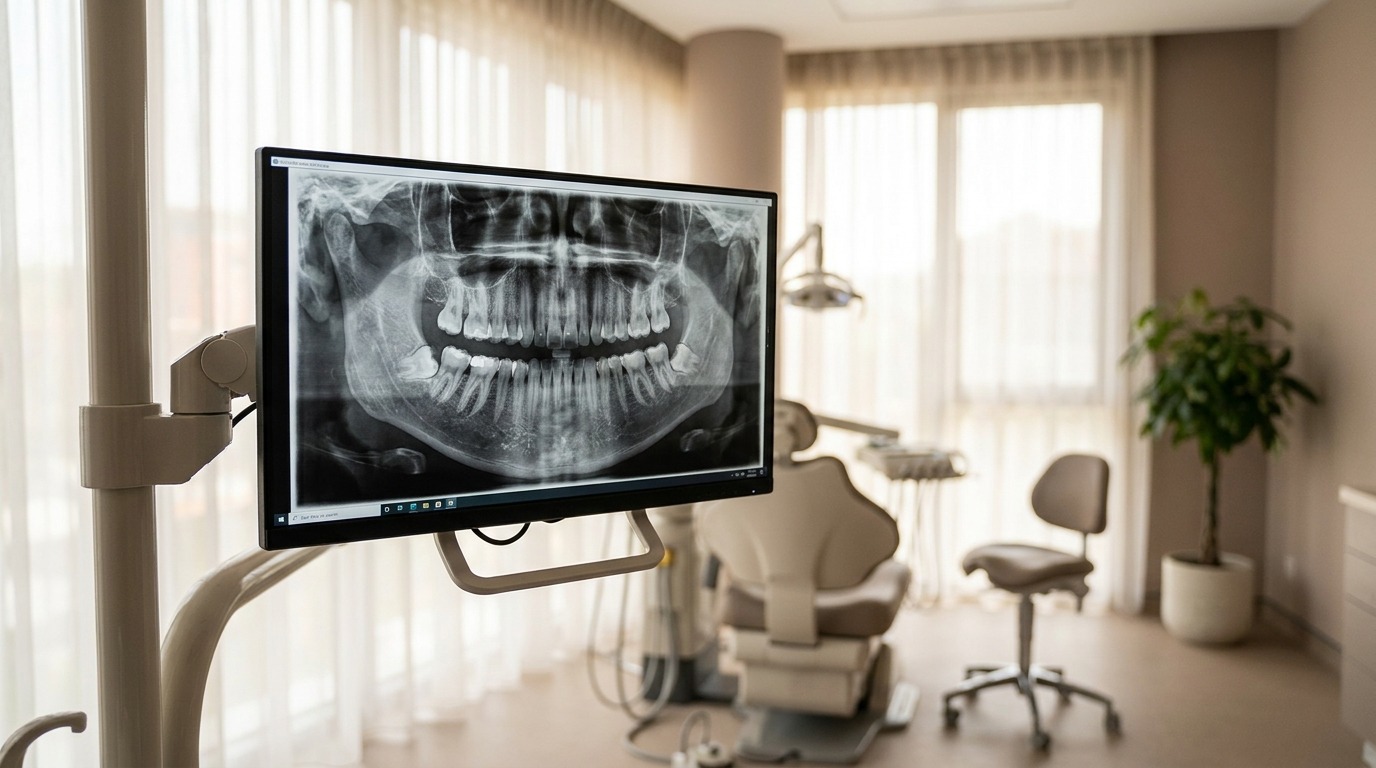
The first three are by far the most common. The X-ray on the left is a classic mesial impaction — the lower right wisdom tooth is angled forward, the crown is pressing into the second molar, and the roots are curled around the nerve canal.
When does an impacted wisdom tooth actually need to come out?
An impacted wisdom tooth should usually be removed when there is evidence of pathology, when it is causing damage to the adjacent second molar, or when the long-term risk of leaving it in is high. The ADA’s position on wisdom tooth management supports prophylactic removal when the risk of future problems is high. The decision is not automatic.
Reasons to remove an impacted wisdom tooth:
- Decay on the second molar — the wisdom tooth is leaning into the back of the second molar and causing decay at a contact point that is not cleanable. Leaving it in usually means losing both teeth eventually.
- Recurrent pericoronitis — repeated infections of the gum flap over a partially erupted wisdom tooth. Common in the 18-25 age window. Each infection is treated with antibiotics, but the next one is just a matter of time.
- Cyst or tumour formation — the tissue around an impacted tooth can develop cysts or, very rarely, tumours. The risk increases the longer the tooth stays impacted.
- Orthodontic reasons — late lower-incisor crowding. The evidence for this is mixed, but in some cases wisdom teeth contribute to relapse of orthodontic treatment.
- Proactive removal in young adults — the surgery is easier, recovery is faster, and the risk of nerve injury is much lower in the late teens and early 20s than in the 40s and beyond.
Reasons to leave an impacted wisdom tooth alone:
- Fully impacted in bone, no symptoms, no pathology, patient over 40 — the surgery is harder, the recovery is slower, and the chance of future problems decreases with age. The risk calculus flips.
- Patient has significant medical compromise — bleeding disorders, bisphosphonate use, immunosuppression. The surgery is higher risk than the likely benefit.
- Tooth is in a position that would damage a nerve or sinus — sometimes the X-ray shows the roots wrapped around the inferior alveolar nerve. A specialist opinion is the right call.
What actually happens during wisdom tooth surgery?
The procedure is a surgical extraction under local anaesthetic (or sedation if needed): the gum is opened, bone is removed if needed, the tooth is sectioned into pieces and removed, the site is cleaned, and the gum is sutured closed. A straightforward lower impacted wisdom tooth takes 20-40 minutes at our practice. Complex cases are referred to a specialist oral surgeon.
What to expect on the day:
- Consent and planning — the dentist walks through the X-ray (panoramic or CBCT) and the surgical plan. The risks are covered in plain language. Consent is signed.
- Local anaesthetic — a strong block plus infiltration. The area is fully numb within minutes. For anxious patients, oral sedation (temazepam) or IV sedation (specialist) is an option.
- Gum flap — a small incision is made to expose the tooth and the surrounding bone.
- Bone removal (if needed) — for deeply impacted teeth, a small amount of bone is removed with a surgical bur to expose the crown. This is the part that produces the most post-op discomfort.
- Sectioning — the tooth is cut into 2-4 pieces with a surgical bur, then each piece is lifted out. Sectioning reduces the amount of bone that needs to be removed.
- Cleaning and suturing — the socket is flushed with saline, the gum is closed with 2-3 dissolving sutures, and gauze is placed for the patient to bite on for 30 minutes.
- Recovery — the patient goes home with written post-op instructions, a script for pain relief if needed, and a follow-up appointment for 1 week.
What is recovery from wisdom tooth surgery actually like?
Most patients are functional within 2-3 days and fully recovered within 1-2 weeks. The first 48-72 hours are the worst — facial swelling, jaw stiffness, mild-to-moderate pain that responds to over-the-counter medication, and a soft-food diet. Better Health Channel is the standard Australian patient reference for the recovery arc.
The realistic timeline, day by day:
- Day 1 (surgery day) — gauze pressure for 30 minutes, then home. Bleeding tapers to oozing. Ice packs 20 minutes on / 20 minutes off. Soft, cold food (yoghurt, smoothies, ice cream). Pain relief as prescribed.
- Day 2-3 — peak swelling and jaw stiffness. This is the worst window. Pain is usually manageable with ibuprofen + paracetamol. Sleep propped up.
- Day 4-5 — swelling starts to come down. Most patients return to desk work or study. Soft food continues.
- Day 7 — follow-up appointment. Sutures usually dissolving by now. Most patients are on a normal diet with care around the site.
- Day 10-14 — site is largely healed on the surface. Bone healing underneath takes 3-6 months but is not felt.
The complications to know about:
- Dry socket (alveolar osteitis) — the blood clot dislodges from the socket, exposing the bone. Pain on day 3-5 that is suddenly worse and not relieved by pain relief. Occurs in 2-5% of routine extractions and up to 30% of lower surgical wisdom tooth removals. Treatable in the chair; not dangerous.
- Infection — uncommon if post-op instructions are followed. Presents as increasing pain, swelling, fever, or a bad taste after day 4-5. Needs antibiotics.
- Nerve injury — rare (well under 1%), usually temporary, but a real risk to discuss before the surgery. The inferior alveolar nerve runs through the lower jaw and can be bruised or damaged during lower wisdom tooth removal. Most cases resolve over weeks to months.
What are the risks of leaving an impacted wisdom tooth in place?
The main risks of leaving an impacted wisdom tooth in place are decay on the adjacent second molar, recurrent infection, cyst formation, and — in a small number of cases — damage to the second molar root severe enough to require its removal as well. The ADA’s guidance is that the calculus usually favours removal in young adults, but the picture is nuanced in older patients.
The honest risk picture:
- Under 25 — removal is usually the right call. Surgery is easy, recovery is fast, nerve injury is rare, and the long-term benefit of preventing second-molar problems is clear.
- 25-40 — depends on the X-ray. Symptomatic or pathological teeth come out. Asymptomatic teeth in accessible positions are usually monitored with periodic X-rays.
- Over 40 — the calculus flips. Surgery is harder, roots are fully formed and closer to the nerve, recovery is slower, and the chance of future problems decreases. Many impacted teeth in this age group are simply monitored for life.
The decision is genuinely individual. A CBCT scan and a discussion with the dentist is the right next step if you are unsure.
How much does wisdom tooth removal cost in Marsden Park?
In Australia, a straightforward wisdom tooth extraction costs roughly $200-$450, and a surgical lower impacted wisdom tooth removal costs roughly $450-$800 per tooth under local anaesthetic alone, more with sedation. The wide range reflects the case complexity — a fully erupted upper wisdom tooth is a routine extraction, a deeply impacted lower wisdom tooth with curved roots is a surgical case. Health fund extras cover for “major dental” often contributes a fixed benefit per tooth, and a standard 2-tooth surgical case is typically rebatable under the annual limit.
The honest answer for a Marsden Park patient: book a consultation with a panoramic X-ray. The dentist will quote an exact figure per tooth, walk through the risks, and check your health fund benefit on the day.
Frequently asked questions (supplementary)
Does wisdom tooth removal hurt? The procedure itself is under local anaesthetic and is not felt. The 2-3 days after are uncomfortable — swelling, jaw stiffness, mild-to-moderate pain — and respond to over-the-counter pain relief.
Can I be sedated for the procedure? Yes. Options range from oral sedation (a tablet) to IV sedation (specialist). For anxious patients, IV sedation makes a long procedure feel like five minutes.
Will I be swollen? Yes, especially for lower surgical removals. Peak swelling is day 2-3 and resolves over the next week. Ice packs in the first 24 hours help.
How long off work or study? 1-2 days for desk work, 3-5 days for physical work, up to a week for contact sport. The dentist gives a case-specific recommendation.
What can I eat? Soft, cold food for the first 48 hours. Yoghurt, smoothies, scrambled eggs, mashed potato. Avoid hard, crunchy, hot, or spicy food for the first week.
When can I exercise again? Light walking from day 1. Light cardio from day 3-4. Heavy lifting and contact sport from day 7.
Ready to start?
If you are between 18 and 30 and have not had your wisdom teeth assessed, a panoramic X-ray at our check-up appointment is the right place to start. If a tooth is already causing pain, swelling, or recurrent infection, our wisdom tooth extraction service handles the case end-to-end. We regularly see patients from neighbouring St Marys, Schofields and Rouse Hill. Book online or call our Dentist Marsden Park practice.


