Knocked-Out Tooth Emergency in Marsden Park
A knocked-out (avulsed) permanent tooth is a genuine time-critical dental emergency. The right action in the first 30 minutes decides whether the tooth survives long-term. At our Dentist Marsden Park practice, MM Dental handles avulsed teeth as a same-day priority under our emergency dentistry service for patients across Marsden Park, St Marys, Schofields, Rouse Hill and the wider northwest Sydney corridor. This page covers exactly what to do in the moment, how to store the tooth, what we do when you arrive, and how to prevent it in the first place.
The single most important sentence on this page: if a permanent tooth is knocked out, get it back into the socket within 30 minutes if at all possible, and do not let it dry out. Everything else is detail.
What should I do in the first 30 minutes after a tooth is knocked out?
Find the tooth, pick it up by the crown only, rinse it briefly with milk or saline if dirty, and try to re-implant it into the socket within 30 minutes — this gives the best chance of long-term survival. If re-implantation is not possible, store the tooth in milk, saline, or Hank’s Balanced Salt Solution and get to a dentist immediately. The Better Health Channel’s mouth and dental injuries page is the standard Australian reference for the protocol.
The first 30 minutes, in order:
- Find the tooth. Search the immediate area. If outdoors, do not assume it is lost — check clothing, the ground, the patient’s hand.
- Pick it up by the crown (the white chewing part). Do not touch the root. Touching the root damages the periodontal ligament cells that allow re-attachment.
- Rinse briefly if dirty — 10 seconds under cold milk or saline. Do not scrub, do not use soap, do not let it dry out.
- Re-implant if you can. For a cooperative adult or older teen, push the tooth gently back into the socket, root first, then have the patient bite gently on a clean cloth to hold it in place. If this is not possible (uncooperative child, severe bleeding, shock), skip to storage.
- Get to a dentist within 30 minutes. Call ahead. Same-day emergency appointments are the standard for this presentation.
The thing most people get wrong: they wrap the tooth in tissue paper or let it sit dry. Both kill the cells on the root surface and make successful re-implantation much less likely.
How should I store the tooth if I can’t get to a dentist immediately?
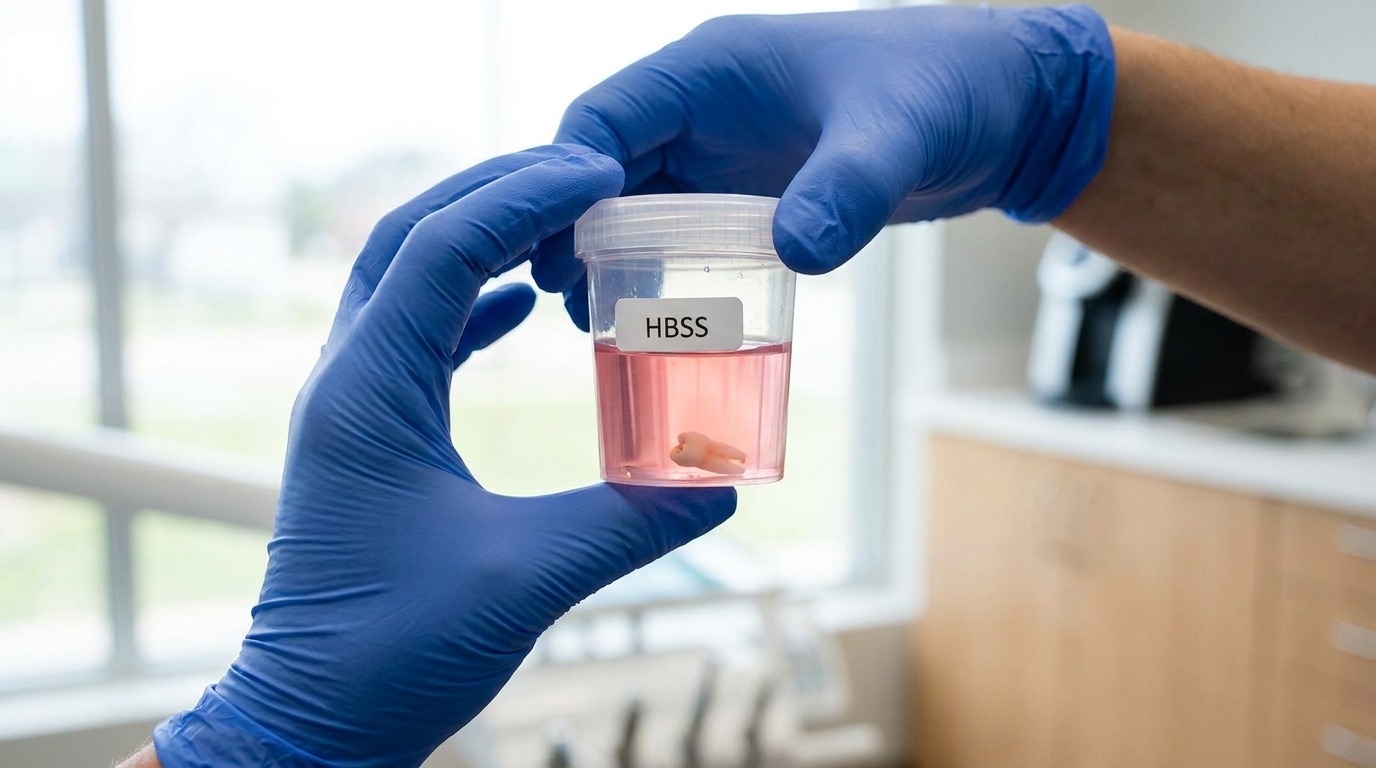
Store the tooth in milk, saline, or Hank’s Balanced Salt Solution (HBSS) — never water, never dry. Milk is the realistic option for most people. HBSS is available in some first-aid kits and school sports kits in Australia. The Australian Dental Association recommends these as the ranked options for short-term storage.
Storage options ranked by availability and effectiveness:
- Hank’s Balanced Salt Solution (HBSS) — the gold standard. Keeps periodontal ligament cells alive for 6+ hours. Sold in Australia as “Save-A-Tooth” kits in some pharmacies and first-aid suppliers. Not universal.
- Cold milk — the practical best. Keeps cells alive for 2-6 hours depending on milk temperature. Use full-fat milk if possible (more isotonic with the cells). The tooth should be fully submerged in a sealed container.
- Saline — acceptable if available, similar performance to milk.
- Saliva — last-resort option. The patient can hold the tooth inside their cheek (only for older children and adults, not young children who might swallow it). The ADA notes this is a real option, not a joke.
- NOT water — kills cells quickly. Pure water is hypotonic and causes the cells to swell and rupture.
- NOT dry — drying kills the cells within minutes. Wrapping in tissue is the worst-case option.
Practical: most Australian households have milk in the fridge and a phone. The realistic plan is to find the tooth, rinse it in milk, store it in milk, and drive to the dentist.
What does the dentist actually do with a knocked-out tooth?
The dentist rinses the tooth, re-implants it if not already done, and splints it to the adjacent teeth for 1-2 weeks while the periodontal ligament re-attaches. Long-term follow-up includes root-canal assessment, monitoring for ankylosis, and decisions about the long-term prognosis. The ADA’s position on dental trauma management describes this as the standard of care.
The full sequence at MM Dental:
- Phone triage — call our emergency line; we slot avulsion cases in within the hour during business hours, and refer to the on-call emergency hospital for after-hours.
- Assessment on arrival — extra-oral dry time (the critical number), storage medium used, associated injuries (lips, gums, jaw), tetanus status, medical history.
- Tooth preparation — if stored in milk or HBSS, the tooth is often directly re-implantable. If dry or stored in water, the prognosis is significantly worse and the discussion is more nuanced.
- Re-implantation and splinting — the tooth is gently seated into the socket, then splinted to the neighbouring teeth with a flexible wire-composite splint for 1-2 weeks. Local anaesthetic is used.
- Root canal decision — for mature permanent teeth, root canal treatment is typically performed 7-10 days after re-implantation to prevent inflammatory root resorption. For immature teeth (open apex in a young patient), the tooth is given the best chance to revascularise first.
- Follow-up — reviews at 2 weeks, 4 weeks, 3 months, 6 months, then annually for at least 3 years. X-rays track the root and the bone.
The realistic outcome: a properly handled permanent tooth re-implanted within 30 minutes has roughly a 90% chance of long-term survival. A tooth dry for more than 60 minutes has a much lower prognosis, and the discussion may shift to replacement options (which is a separate page on this site).
What if a baby tooth is knocked out?
Do not try to re-implant a baby (deciduous) tooth — re-implantation risks damaging the underlying permanent tooth bud, which is a worse outcome than losing the baby tooth. Apply pressure to stop bleeding, give the child comfort, and see a dentist for a check within 24 hours. The Better Health Channel is clear on this point.
The practical guidance for parents:
- Control bleeding — clean gauze pressed firmly against the gum for 10 minutes. Do not keep peeking; the clot needs undisturbed time to form.
- Find the tooth but do not re-implant — the root of a baby tooth is designed to resorb. Forcing it back can damage the adult tooth underneath, sometimes fatally for the adult tooth.
- Check for other injuries — lips, tongue, the rest of the mouth. A lip laceration that hides a piece of tooth is the classic missed injury.
- See a dentist within 24 hours — to check the gum, the underlying permanent tooth bud (X-ray), and any associated injuries. A space maintainer may be needed later to hold the gap for the adult tooth.
- Long-term monitoring — the adult tooth may erupt with some enamel discolouration (called Turner tooth) depending on the age at injury. The dentist will track this through the check-up cycle.
For parents: the most useful mindset is that baby teeth are placeholders, and the goal is to protect the adult teeth that are still developing in the bone.
How can knocked-out teeth be prevented?
Custom-fitted sports mouthguards reduce the risk of dental avulsion by roughly 60-80% during contact sport, which is the single most common cause of knocked-out teeth in Australians under 25. The Healthdirect dental-care page reinforces the mouthguard recommendation as the primary prevention. A standard off-the-shelf “boil-and-bite” guard offers some protection but a custom guard from a dentist is materially better.
The at-risk groups and situations:
- Contact sport players — rugby, AFL, hockey, martial arts, basketball, soccer. A custom mouthguard is a season essential, not optional.
- Skaters and scooter riders — falls at speed are a common avulsion cause in the 10-19 age group.
- Climbers and cyclists — high-speed falls to the face.
- Anyone with prominent upper front teeth — increased overjet means the upper incisors sit forward and are more vulnerable to trauma. Orthodontic treatment in childhood reduces this risk long-term.
- Anyone who has had previous dental trauma — a previously traumatised tooth is statistically more likely to be re-injured. A custom guard is even more important.
If you or your child plays any contact sport and has not had a custom mouthguard fitted in the last 12 months, it is worth a quick appointment. A standard check-up is the right place to raise it.
Frequently asked questions (supplementary)
Is a knocked-out tooth always salvageable? No. The two big factors are extra-oral dry time and storage medium. Dry time over 60 minutes or storage in water both significantly reduce the prognosis. Talk to the dentist about replacement options (implants, bridges, partial dentures) for non-salvageable cases.
What about the mouth and lips — can they be injured at the same time? Yes. Lacerations to the lips, tongue and inside of the cheeks are common. If a piece of tooth is missing and the lip is bleeding heavily, the tooth fragment may be in the lip. A dentist checks this with a lip X-ray if needed.
Does re-implanting a tooth hurt? Local anaesthetic is used at the dentist. The trauma itself is usually more painful than the re-implantation. Over-the-counter ibuprofen and paracetamol handle the post-op discomfort.
How long does the splint stay on? Typically 1-2 weeks for a clean avulsion. Longer for associated fractures. The dentist removes it at a follow-up visit.
Will I need a root canal? For mature permanent teeth, almost always, 7-10 days after re-implantation. For immature teeth (children, teens with open roots), the tooth may revascularise on its own and a root canal is avoided.
Ready to start?
If you are reading this because a tooth has just been knocked out, call our Dentist Marsden Park practice immediately for emergency triage. We slot avulsion cases in within the hour during business hours. After hours, the nearest public hospital emergency department is the right call. For neighbouring St Marys and surrounding suburbs, the same number applies.