
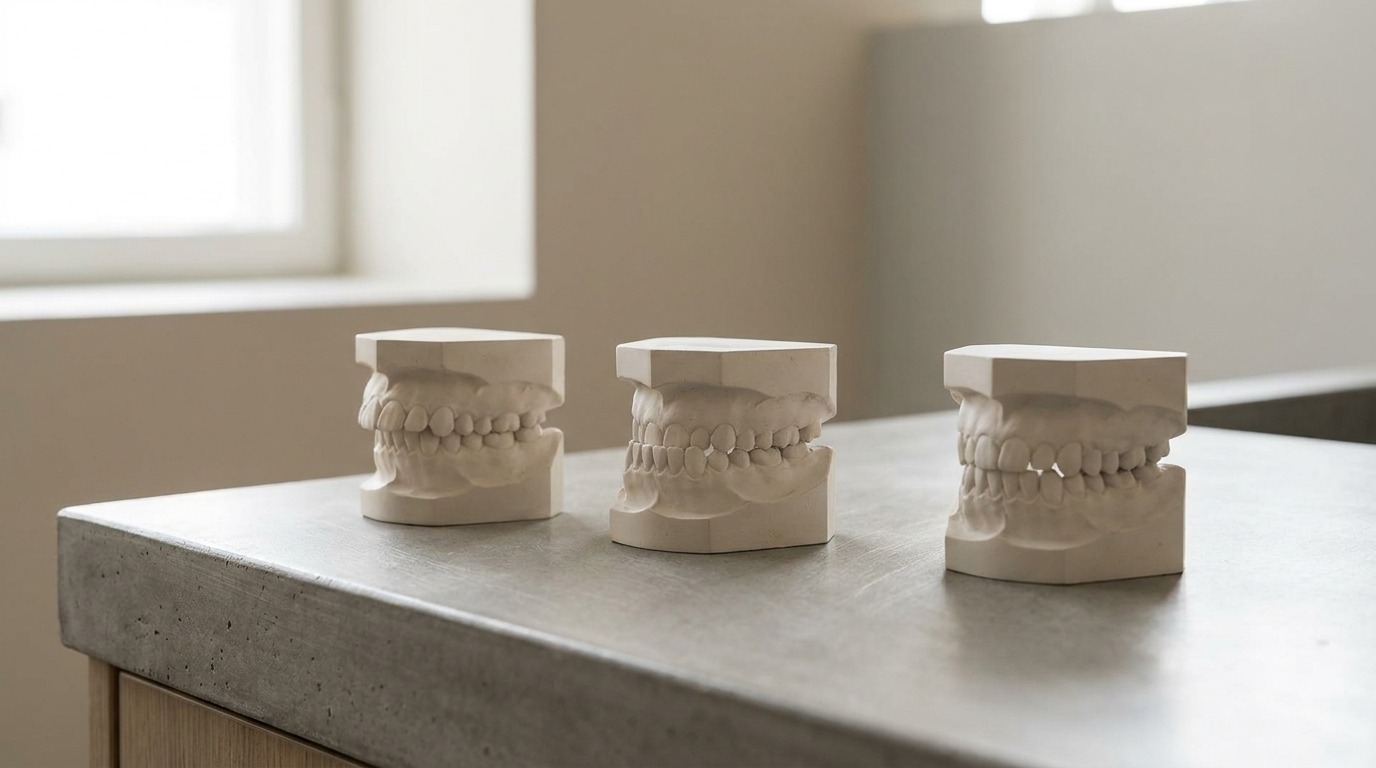
Overbite, Underbite & Crossbite Treatment in Marsden Park
Bite problems — overbite, underbite, crossbite, open bite — are often dismissed as cosmetic, but the more significant ones affect chewing function, speech, jaw joint health, and the long-term survival of the teeth themselves. At our Dentist Marsden Park practice, MM Dental diagnoses and treats bite problems as part of our orthodontics service for patients across Marsden Park, St Marys, Schofields and the surrounding northwest Sydney suburbs. This page covers what each bite problem actually is, why they need to be fixed, the treatment options that work, and how to know if your case is one we can handle in-house or one that needs a specialist surgical team.
The single most useful thing to know upfront: a bite problem is not just a cosmetic issue. The right treatment depends on whether the cause is dental (tooth position) or skeletal (jaw position), and the distinction is what determines whether orthodontics alone is enough.
What is the difference between an overbite, an underbite, and a crossbite?
An overbite is when the upper teeth overlap the lower teeth vertically more than normal. An underbite is when the lower teeth sit in front of the upper teeth (the opposite of the usual relationship). A crossbite is when the upper teeth sit inside the lower teeth when the mouth is closed — the upper and lower arches do not line up. The Australian Dental Association uses the Angle’s classification system to describe these, and Better Health Channel’s teeth-straightening page is the standard patient reference.
The four main bite problems, with the everyday description and the clinical name:
Overbite (deep bite) — the upper front teeth cover too much of the lower front teeth when the mouth is closed. Mild overbite is normal and healthy. A deep overbite (more than about 4-5mm of vertical overlap) can drive the lower front teeth into the gum behind them, wear down the lower incisors, and stress the jaw joints. Often genetic.
Underbite (Class III malocclusion) — the lower front teeth sit in front of the upper front teeth. The lower jaw appears to protrude. Often skeletal (the lower jaw is positioned forward), particularly in adults. Can be mild and cosmetic, or severe and functional.
Crossbite — when biting down, some upper teeth sit inside the lower teeth instead of outside. Can affect a single tooth (a single-tooth crossbite) or a whole side of the bite (a posterior crossbite). Often caused by a narrow upper jaw. A posterior crossbite in a child can lead to asymmetric jaw growth if untreated.
Open bite — when the back teeth are together, the front teeth do not meet. Often caused by a prolonged thumb-sucking or tongue-thrust habit in childhood, or by a skeletal discrepancy. Affects speech (lisping) and the ability to bite through food with the front teeth.
There is also the everyday “overbite” that most people mean when they say their upper teeth stick out — that is technically called an increased overjet, not an overbite. The terms are often used interchangeably, but the clinical distinction matters for treatment.
Why does a bite problem need to be fixed?
Untreated bite problems contribute to abnormal tooth wear, jaw joint (TMJ) disorders, gum recession, difficulty maintaining oral hygiene, and — in severe cases — damage to the supporting bone around the teeth. The Better Health Channel and the ADA’s orthodontic guidance cover the long-term consequences.
The case for treatment, by problem:
Deep overbite — the lower front teeth are driven into the gum behind them, causing wear on the incisal edges and potential gum recession. The jaw joint compensates for the bite discrepancy, often leading to TMJ symptoms (clicking, pain, limited opening). Over decades, the result is worn-down lower teeth and joint damage.
Underbite — the front teeth do not meet properly, so the patient chews on the back teeth only. The back teeth wear prematurely. Speech can be affected (lisping on “s” and “t” sounds). In severe cases, the patient cannot bite through a sandwich with the front teeth.
Crossbite — the asymmetric bite causes the jaw to shift to one side to find a comfortable position. Over time, this can lead to facial asymmetry, TMJ symptoms, and accelerated wear on the side that takes more force.
Open bite — speech is affected, biting into food is difficult, and the back teeth bear excessive force as the front teeth cannot guide the bite.
The honest framing: not every bite problem needs treatment. A mild overbite is normal. A small midline shift may be acceptable. The decision to treat is based on the severity, the symptoms, and the long-term prognosis if left alone. A consultation with photos, models, and X-rays is the right way to find out which side of the line your case is on.
How are bite problems actually corrected?
Bite problems are corrected by orthodontics alone if the cause is dental (tooth position), or by a combination of orthodontics and orthognathic (jaw) surgery if the cause is skeletal (jaw position). The ADA’s orthodontic guidance is clear on this distinction. The right answer depends on what the records show.
The two treatment paths:
Dental (orthodontic-only) treatment — the jaws are in a normal relationship, but the teeth are positioned in a way that creates the bite problem. Braces or clear aligners move the teeth into the correct position. Typical adult treatment time: 12-24 months. Cost: $4,500-$9,500 for full upper-and-lower.
Skeletal (orthognathic surgery) treatment — the jaws themselves are in the wrong relationship. Orthodontics alone cannot fix this. The case is referred to a specialist oral and maxillofacial surgeon, who works with the orthodontist. The patient wears braces for 12-18 months before the surgery, has the surgery (1-3 days in hospital, 2-4 weeks off work), then wears braces for another 6 months. Total treatment time: 24-36 months. Cost: $15,000-$30,000+ for the orthodontic phase plus the surgical phase, with some surgical fees rebatable by Medicare and private health insurance.
For each bite problem, the typical treatment path:
Deep overbite — usually dental. Intrusion of the upper incisors, extrusion of the posterior teeth, or a combination. Often treated with clear aligners or fixed braces. Some severe cases need bite-opening with temporary anchorage devices (TADs).
Underbite — often skeletal in adults. Mild cases can be camouflaged with orthodontics alone (extractions of lower premolars, retraction of the lower incisors). Moderate to severe cases need orthognathic surgery.
Crossbite — usually dental in children (a palatal expander widens the upper jaw in 1-2 weeks of activation). In adults, the bone is fused and expansion is not possible without surgery; alternative is dental compensation with orthodontics.
Open bite — depends on the cause. Habit-based open bites respond to orthodontics after the habit is broken. Skeletal open bites usually need surgery.
The honest framing: the case planning is the critical part. A consultation with records — photos, study models, panoramic X-ray, sometimes a CBCT — is the only way to know whether orthodontics alone will work or whether surgery is part of the case.
What is orthognathic surgery and when is it needed?
Orthognathic surgery is the surgical repositioning of the upper jaw, lower jaw, or both, performed by a specialist oral and maxillofacial surgeon under general anaesthetic in hospital. The ADA’s orthodontic guidance describes it as the standard of care for severe skeletal malocclusion in adults. The surgery itself is usually 1-3 hours, with 1-2 nights in hospital and 2-4 weeks off work or study.
The typical patient journey for a surgical-orthodontic case:
Orthodontic preparation (12-18 months) — braces are placed and the teeth are aligned in preparation for the surgery. This is the opposite of what patients expect: the bite often gets worse during this phase as the teeth are decompensated (moved into a position that will be neutral once the jaws are repositioned).
Surgery (1-3 hours under general anaesthetic) — the surgeon repositions the jaw(s) through incisions inside the mouth (no external scars). The jaws are fixed in the new position with titanium plates and screws.
Recovery (2-4 weeks off work, 6-8 weeks to near-normal function) — the first week is the worst, with facial swelling, a liquid diet, and difficulty speaking. The swelling resolves over 2-3 weeks. Most patients are back at work by week 3-4.
Orthodontic finishing (6 months) — the braces are used to fine-tune the bite after surgery.
Retention (lifetime) — a fixed retainer plus a removable Essix retainer, same as for orthodontic-only cases.
The honest framing: orthognathic surgery is a big commitment and not something to enter lightly. For the right case (severe skeletal malocclusion that orthodontics alone cannot fix), the result is transformative. For the wrong case, the cost, time, and risk outweigh the benefit. The case planning with a specialist team is the critical part.
Can children with bite problems be treated?
Yes — and the earlier the better, because the jaw bones are still growing and can be guided with appliances that would not work in adults. The Better Health Channel’s orthodontic guidance for children is clear on this point. Early intervention is often called “Phase 1” orthodontics, with a second “Phase 2” treatment in adolescence if needed.
The common early interventions:
Palatal expander — for a narrow upper jaw causing a crossbite. The expander is bonded to the upper molars, and a key is turned daily for 1-2 weeks. The upper jaw widens by 4-10mm. Best done in children aged 7-12, before the mid-palatal suture fuses.
Functional appliance — for a developing underbite or excessive overjet. The appliance guides jaw growth and is worn full-time for 9-12 months. Best done in children aged 9-12, during the growth spurt.
Habit appliance — for an open bite caused by thumb-sucking or tongue thrust. A fixed or removable appliance interrupts the habit and allows the bite to close.
Space maintainer — for early loss of a baby tooth. Holds the space for the adult tooth to erupt, preventing future crowding.
The honest framing: not every child needs early orthodontics. A consultation with a dentist or orthodontist at age 7-8 is the right way to find out whether your child’s case needs intervention now or can wait until adolescence.
Frequently asked questions (supplementary)
At what age should a bite problem be assessed? Around age 7-8. The adult teeth are starting to erupt, the jaw bones are still growing, and any developing problems can be identified early. Most children do not need treatment at this age, but the ones who do benefit enormously from early intervention.
Can clear aligners fix bite problems? Mild to moderate cases, yes. Severe cases, particularly skeletal malocclusions, need fixed braces or surgery. The case planning is the part that determines whether aligners will work for your case.
Does orthodontic treatment for a bite problem hurt? Discomfort, not pain. Teeth are sore for 2-3 days after each adjustment or aligner change. Over-the-counter pain relief handles it.
How long does surgical-orthodontic treatment take? 24-36 months total, with the surgery itself being 1-3 hours. The recovery from the surgery is 2-4 weeks off work.
Will my insurance cover orthognathic surgery? Often yes, partially. The surgical phase is usually covered by Medicare (for the hospital and surgeon fees) and by major dental extras cover for the orthodontic phase. The exact coverage depends on the fund and the policy.
Can a bite problem come back after treatment? Without a retainer, yes. With a permanent retainer worn as prescribed, no. The relapse risk is the same as for any orthodontic case.
Ready to start?
A 30-minute consultation at our Dentist Marsden Park practice is the right place to start. We will look at your bite, take records, and recommend the right treatment — orthodontics alone, orthodontics with Invisalign, or a surgical-orthodontic case referred to a specialist team. Our orthodontics service handles the full scope. We regularly see patients from neighbouring St Marys and across the wider northwest Sydney corridor. Book online or call our practice.


