
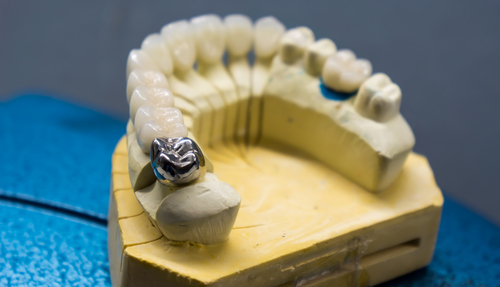
There is a moment in the life of a back tooth that almost nobody sees coming. A filling has been replaced once, perhaps twice, each time a little larger than the last, and then one day the recommendation changes and dental crowns enter the conversation.
It can feel like an escalation out of nowhere. It is not. It is the predictable end point of a process that has been running quietly for years, and understanding it makes the recommendation obvious rather than surprising.
A Tooth Is a Structure, Not a Lump
It helps to stop thinking of a molar as a solid block and start thinking of it as an engineered shell. The outer walls of enamel are rigid and strong, and they are joined together at the top by the biting surface, which ties the whole thing into a single stiff box.
That geometry is what lets a back tooth survive decades of chewing forces that would snap the same volume of material in a different shape. The strength is in the arrangement, not just the substance, and the arrangement depends on the walls being connected.
For general guidance, the Australian Dental Association is a reliable source.
A filling, by necessity, opens that box. To remove decay you must cut through the biting surface into the middle of the tooth, and what is left behind is a shell with a hole in the roof and two or more unsupported walls standing on their own. A small filling barely disturbs the structure. A large one changes it fundamentally.
Why Each Filling Is Bigger Than the Last
Fillings do not last forever, and every time one is replaced the cavity is prepared again, which means the tooth is a little smaller each time around.
| What happens over time | The structural effect |
| A small filling is placed | Almost no loss of strength |
| Decay reappears at the margin | The cavity is prepared wider |
| The filling is replaced | More tooth structure is removed |
| The walls become thinner | Each cusp stands more alone |
| A cusp flexes under load | Cracks begin at the base |
| A cusp fractures | Often below the gumline |
This is the sequence that matters, and the important thing about it is that nothing has gone wrong at any individual step. Each filling was the right treatment at the time. It is the accumulation that eventually leaves a tooth with tall, thin walls and very little holding them together.
A cusp in that state does not break on a hard object particularly often. It usually goes on something entirely ordinary, because the crack had been quietly propagating for months and the sandwich was simply the last load it saw.
What a Crown Does Differently
A filling sits inside the tooth and relies on the surrounding walls to hold it and to hold themselves. That is a perfectly good arrangement when the walls are substantial, and it is why most teeth never need anything more.
A crown works the other way around. It sits over the tooth, covering the biting surface and wrapping the walls, so that the chewing load is carried by the crown and passed down through the tooth rather than pushing the weakened cusps apart.
That is the entire distinction, and it is worth being precise about it. A filling replaces missing tooth. A crown protects remaining tooth. Once the walls are thin enough that they are the problem, adding more filling material inside them does nothing to help, because it is not the hole that is failing, it is the shell around it.
Crowns and bridges are made from porcelain or zirconia and are shaped to the tooth so that they restore its original outline, so a crowned molar bites, feels and works like a molar. The tooth carries on doing its job; it simply has a stronger roof over it than it could provide for itself.
Why Timing Is the Whole Game
A crown recommended on a heavily filled but intact tooth is a straightforward piece of work with a predictable outcome. The tooth is prepared, the crown is fitted, and the story ends there.
The same tooth left until a cusp actually fractures is a different proposition, and the difference is not the crown, it is where the fracture lands. Cusps tend to shear off at an angle, and the break frequently runs below the gumline, which can leave too little sound tooth above the gum for a crown to grip.
Where that happens, the conversation moves on to root canal treatment, to building the tooth back up, or in the least fortunate cases to whether the tooth can be kept at all. None of that was inevitable. It followed from waiting for the tooth to make the decision.
This is why a dentist will sometimes recommend a crown on a tooth that feels perfectly comfortable. It is not that something is wrong today. It is that the structural arithmetic has been visible on the X-ray for some time, and acting while the tooth is whole keeps every option open.
Protecting a Heavily Filled Tooth in Marsden Park
A tooth that has been filled several times is not a failure. It is a tooth that has been saved several times, and at some point it deserves a stronger roof than it can build for itself.
For anyone weighing up dental crowns in Marsden Park and nearby suburbs such as Riverstone, Parklea and Blacktown, an examination with X-rays shows how much sound structure is left and whether the walls are still doing their job.
From there, the dental team can walk you through what they can see and what it means, with no pressure.
The Takeaway
A molar is not a solid lump but an engineered shell, and its strength comes from the walls being tied together by the biting surface. Every filling opens that structure, and because fillings are eventually replaced and each replacement is a little wider, a heavily restored tooth ends up with tall, thin walls standing largely on their own. A cusp in that state usually fractures on something entirely ordinary, and it often breaks below the gumline, which is what turns a simple problem into a complicated one. A crown works differently from a filling: it sits over the tooth and wraps the walls, so the load is carried across the tooth rather than pushing the cusps apart. Acting while the tooth is still whole keeps every option open. The team at M&M Dental Care is happy to explain, with no pressure.
Frequently Asked Questions
Why do I need a crown instead of another filling?
A filling sits inside the tooth and relies on the surrounding walls to support it. Once repeated fillings have left those walls thin, they become the weak point, and more filling material inside them changes nothing. A crown sits over the tooth and wraps the walls, so chewing load is carried across the tooth rather than pushing the cusps apart.
Why does a tooth need a crown if it does not hurt?
Because the structural weakness is visible long before it produces symptoms. A crown placed on a heavily filled but intact tooth is straightforward and predictable. The same tooth left until a cusp shears off can fracture below the gumline, which may leave too little sound tooth to work with and turns a simple job into a complicated one.
What is the difference between a filling and a crown?
A filling replaces missing tooth structure and sits within the remaining walls. A crown protects the remaining tooth structure by covering the biting surface and wrapping the walls. Fillings suit teeth whose walls are still substantial; crowns suit teeth where the walls themselves have become the vulnerable part.
What are dental crowns made from?
Crowns are commonly made from porcelain or zirconia, and they are shaped to restore the original outline of the tooth. A well-made crown allows a molar to bite, feel and function as a molar, with the difference being that the chewing load is now carried by a restoration stronger than the weakened tooth beneath it.
Can a cracked cusp be repaired with a filling?
Sometimes, depending on where the fracture runs. Cusps tend to shear at an angle, and when the break extends below the gumline there may be too little sound tooth above the gum for a restoration to grip. That is precisely why a crown is often recommended before a fracture happens rather than after.
This blog is intended for general informational purposes only and does not constitute medical or dental advice. Every patient’s oral health needs are unique. Please consult a qualified dental practitioner for advice specific to your situation. M&M Dental Care encourages all patients to seek a professional assessment before commencing any dental treatment.
