
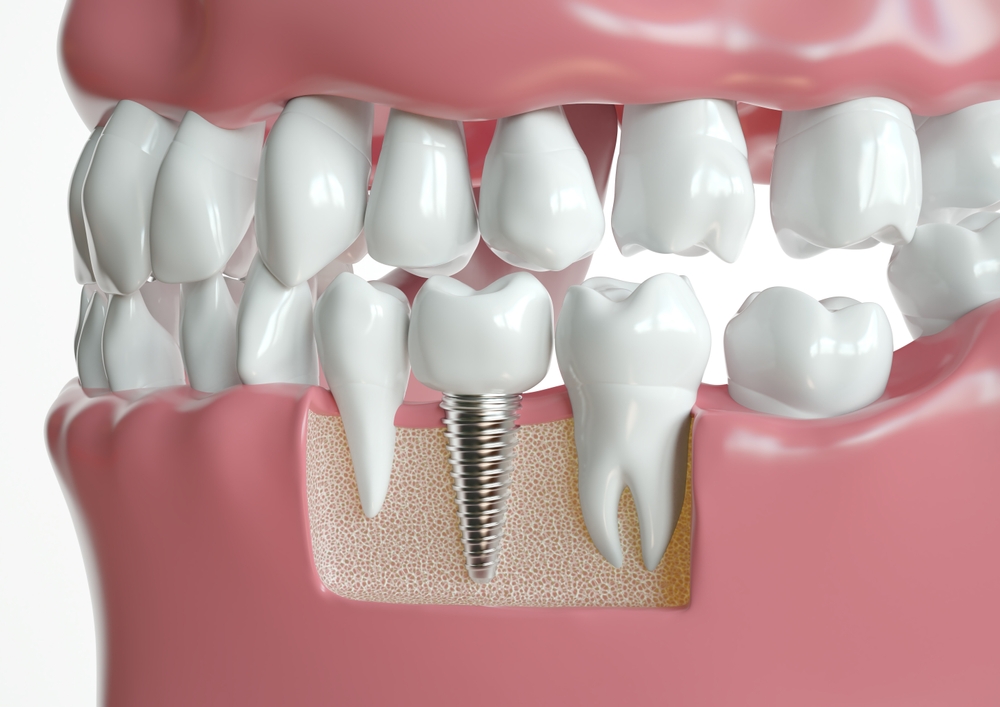
Dental implants are usually described in terms of what you can see: a replacement tooth that looks and works like the one it replaced. That is accurate, and it undersells the interesting part entirely.
The genuinely remarkable thing happens where nobody can look. A titanium post is placed into the jaw, and over the following months living bone grows onto its surface and locks it in place. Understanding that process explains almost every question people ask about implants, starting with why they take so long.
Bone Does Not Tolerate Metal. It Adopts It
Put most materials into bone and the body treats them as an intruder. It walls them off in a layer of soft fibrous tissue, keeping them at arm’s length, and anything held that way stays slightly loose forever.
Titanium behaves differently. Its surface forms a stable oxide layer that the body does not react against, and instead of walling it off, bone cells migrate onto it, lay down new bone directly against the surface and eventually bond to it.
A general overview is available from health authorities such as healthdirect.
That process is called osseointegration, and it is the whole basis of implant dentistry. It is not a screw held tight by friction, in the way a screw is held in a wall. It is a post that living bone has grown onto and taken ownership of, which is a fundamentally more durable arrangement.
Why It Takes Months
The waiting is the part people find hardest to accept, and it makes complete sense once you see what is happening week by week.
| Stage | What the bone is doing |
| Placement | The implant sits in a precisely prepared site |
| First days | A blood clot forms against the surface |
| Early weeks | New bone begins forming on the implant |
| Middle period | Immature bone is progressively replaced |
| Later weeks | Bone remodels and becomes load-bearing |
| Restoration | The replacement tooth is fitted on top |
Bone is not glue and it does not set. It is a living tissue that builds, then remodels what it built, then strengthens it in response to load, and that sequence runs on a biological timetable which cannot be hurried by wanting it to be quicker.
The healing period is therefore not a delay in the treatment. It is the treatment. Everything that gives an implant its long-term strength is happening during exactly the months when, from the outside, nothing appears to be happening at all.
The Argument Nobody Mentions: Load
There is a reason implants are discussed differently from bridges and dentures, and it has to do with what happens to the jaw when a tooth is missing.
Bone maintains itself in response to load. A natural tooth root passes chewing forces into the bone surrounding it, and that stimulus is part of what tells the bone to stay where it is. Remove the root and the stimulus goes with it, and research suggests the bone in that area gradually reduces.
A bridge spans the gap and restores the tooth beautifully above the gum, but it rests on the neighbouring teeth and does nothing for the bone underneath the gap, which continues on its own trajectory. A denture sits on top of the gum and, similarly, does not load the bone below.
An implant is the only replacement that puts force back into the bone the way a root does. That is not a small footnote. It is a structural argument for considering implants that has nothing to do with appearance, and it is the reason the conversation is worth having sooner rather than later.
What Makes an Implant Suitable
Because the whole thing depends on bone, the assessment is largely about bone: how much of it there is, how dense it is, and where the important structures sit relative to the proposed site. That is established with imaging rather than by looking.
General health matters too, since osseointegration is a healing process and anything that impairs healing affects it. Smoking is the clearest example, and well-managed general health supports the outcome. This is discussed openly at the assessment rather than treated as a hurdle.
Gum health is part of it as well. The tissue around an implant needs to be healthy and stable, so any active gum disease is dealt with first, which is one of the reasons preventative dentistry and implant planning are so closely connected.
Where bone volume is limited, that is not automatically the end of the conversation, and options exist. The purpose of the assessment is to establish what is realistic for your particular jaw rather than to apply a general rule to it.
Discussing Dental Implants in Marsden Park
An implant is worth understanding properly, because the thing that makes it work is invisible and takes time, and both of those facts are easier to accept once you know what they are for.
For anyone considering dental implants in Marsden Park and nearby suburbs such as Riverstone, Parklea and Blacktown, an assessment with imaging establishes how much bone is available and whether an implant is a realistic option.
From there, the dental team can explain each stage and what to expect from it, with no pressure.
The Takeaway
An implant works because of something that happens where nobody can see it. Most materials placed in bone are walled off in fibrous tissue and stay slightly loose, but titanium forms a stable surface that bone grows directly onto and bonds with, a process called osseointegration. That is why the healing months are not a delay in the treatment but the treatment itself: bone builds, remodels and then strengthens in response to load on a biological timetable. It is also why implants are discussed differently from bridges and dentures. Bone maintains itself in response to load, and an implant is the only replacement that puts force back into the bone the way a natural root does. The team at M&M Dental Care is happy to explain, with no pressure.
Frequently Asked Questions
How does a dental implant stay in the jaw?
Through a process called osseointegration. Titanium forms a stable surface that the body does not react against, so instead of walling it off in fibrous tissue, bone cells migrate onto it and lay down new bone directly against the surface. The implant is held because living bone has grown onto it, not by friction alone.
Why do dental implants take several months?
Because bone is a living tissue that builds, remodels and then strengthens in response to load, and that sequence runs on a biological timetable. The healing period is not a delay before the treatment works; it is the period during which everything that gives the implant its long-term strength is actually happening.
Do implants help preserve the jawbone?
Bone maintains itself in response to load. A natural tooth root passes chewing forces into the surrounding bone, and once the root is gone that stimulus disappears, so research suggests the bone gradually reduces. An implant puts force back into the bone the way a root does, which a bridge or a denture resting on the gum does not.
What makes someone suitable for a dental implant?
The assessment is largely about bone: how much is available, how dense it is, and where important structures sit, which is established with imaging. General health and healing capacity matter, since osseointegration is a healing process, and gum health needs to be stable, so any active gum disease is addressed first.
Is an implant stronger than a bridge?
They work in different ways rather than competing directly. A bridge is supported by the neighbouring teeth and restores the gap above the gum. An implant is supported by the bone itself and is the only option that loads the bone beneath the gap. Which suits you depends on your bone, your gums and the teeth either side.
This blog is intended for general informational purposes only and does not constitute medical or dental advice. Every patient’s oral health needs are unique. Please consult a qualified dental practitioner for advice specific to your situation. M&M Dental Care encourages all patients to seek a professional assessment before commencing any dental treatment.


