
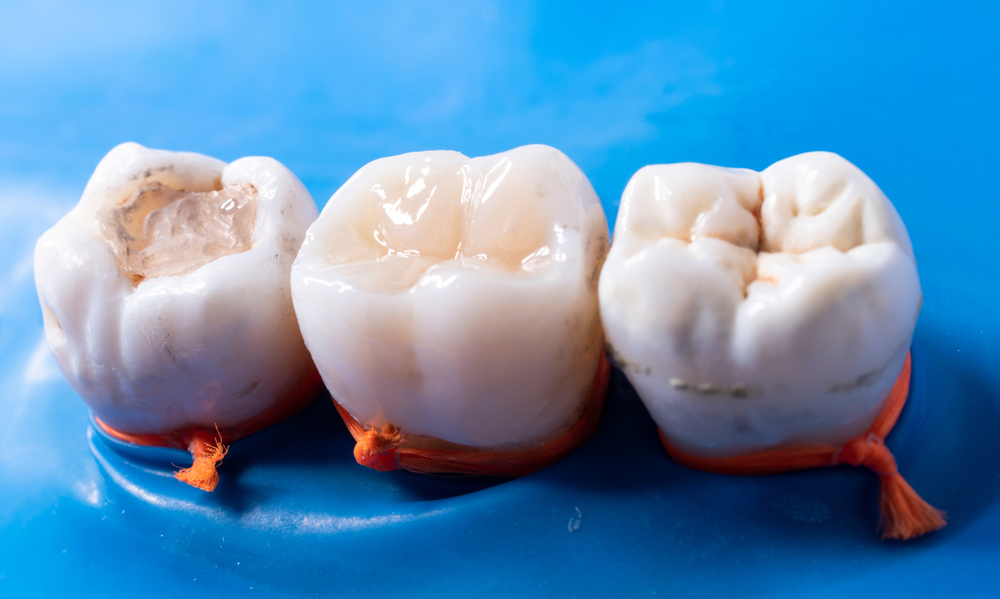
Most people assume that a tooth-coloured filling is simply a filling that happens to be white, chosen because it looks better. The appearance is the obvious difference, and it is the least interesting one.
The real change is mechanical. Composite bonds chemically to the tooth, and the older materials did not, and that single distinction changes how a cavity is prepared, how much healthy tooth has to be sacrificed, and how the finished tooth behaves under load.
The Problem With Something That Does Not Stick
A material that does not bond to the tooth has to be held in some other way, and the only way available is shape. It has to be mechanically locked in, which means the cavity must be cut with undercuts, so the filling is physically trapped and cannot come out.
That has a consequence worth stating plainly. To create that shape, healthy tooth structure beyond the decay itself has to be removed. The preparation is dictated partly by the disease and partly by the requirements of the material.
For general guidance, the Australian Dental Association is a reliable source.
Composite changes the arrangement entirely. Because it bonds to enamel and dentine, it does not need to be trapped, so the preparation can be limited much more closely to the decay that actually has to go. More healthy tooth stays in the tooth, which matters a great deal over a lifetime of restorations.
How the Bond Is Made
The bonding process is precise, and understanding it explains why a filling appointment involves several distinct stages rather than one.
| Stage | What it achieves |
| Decay is removed | Only the affected structure is taken |
| The surface is conditioned | It becomes microscopically rough |
| Bonding agent is applied | It flows into the roughened surface |
| Composite is placed in layers | Each layer is shaped and cured |
| A curing light sets each layer | The material hardens on command |
| The filling is shaped and polished | The bite and contour are refined |
The conditioning step is where the interesting chemistry happens. It creates a microscopically rough surface, and the bonding agent flows into it and hardens, forming an interlocking layer at the join. The composite is then chemically joined to that layer, so filling and tooth become continuous.
The layering matters too. Composite is placed and cured in increments rather than in one mass, which controls shrinkage as it sets and lets the shade and translucency be built up so that the finished restoration blends with the tooth around it.
What the Bond Actually Buys You
The aesthetic result is the part everyone notices, and it is genuine: a well-placed composite is difficult to see, which matters most on front teeth and on the visible edges of premolars.
The structural benefit is quieter and arguably more valuable. A bonded restoration is joined to the walls of the tooth rather than sitting inside them as a separate piece, and that helps the remaining tooth structure work as a unit under load rather than as loose walls around a plug.
The conservatism is the third gain, and it compounds. Because the preparation removes less healthy tooth, the tooth that is left is stronger, and a stronger tooth is a tooth that is less likely to need a crown in fifteen years. Every millimetre of tooth kept today is a millimetre still available later.
There is a sealing benefit as well. A bonded margin closes the join between filling and tooth, which is exactly where new decay likes to begin, and a well-sealed margin is one of the things that determines how long a restoration lasts.
Where Composite Is and Is Not the Answer
Composite is not a universal solution, and being clear about its limits is what makes it a good choice where it is used. It is a filling material, and its job is to restore a cavity within a tooth whose walls are still sound.
Where a tooth has lost a great deal of structure, no filling material solves the underlying problem, because at that point the walls themselves are the weak point rather than the hole between them. That is the territory of crowns and bridges, which cover and protect rather than fill.
The same bonding technology is used cosmetically as well, to close a small gap, repair a chipped edge or reshape a tooth, and it is one of the more conservative options in cosmetic dentistry because it usually removes very little tooth to achieve the result.
How long a composite filling lasts depends on the size of the restoration, where it sits in the mouth, the forces it takes, and how well the area is kept clean. Those are the things worth discussing at a check-up, because they are the things that actually determine the outcome.
Restoring a Tooth Well in Marsden Park
A filling is a small thing that gets done to a tooth many times over a lifetime, and how conservatively it is done compounds over the years.
For anyone needing tooth-coloured fillings in Marsden Park and nearby suburbs such as Riverstone, Parklea and Blacktown, a check-up establishes what needs restoring and how much of the tooth can be preserved while doing it.
From there, the dental team can explain what they are seeing and what they would recommend, with no pressure.
The Takeaway
A tooth-coloured filling is not simply a white version of an older one. Composite bonds chemically to enamel and dentine, and that changes the mechanics. A material that does not bond has to be locked in by shape, which means cutting undercuts and removing healthy tooth beyond the decay itself. A bonded material does not need to be trapped, so the preparation can be kept much closer to the decay, and more of the tooth survives. The bond also joins the restoration to the walls of the tooth so the whole structure works as a unit, and it seals the margin where new decay tends to start. Composite is a filling material, though, and once the walls themselves are the weak point, a crown is the appropriate answer. The team at M&M Dental Care is happy to explain, with no pressure.
Frequently Asked Questions
What is a tooth-coloured filling made of?
Composite resin, a tooth-coloured material that is placed in layers and hardened with a curing light. It bonds chemically to enamel and dentine rather than being held in place by shape alone, and it can be shaded and polished so that the finished restoration blends with the tooth around it.
Why does a bonded filling preserve more tooth?
A material that does not bond has to be mechanically trapped, which means cutting the cavity with undercuts and removing healthy tooth beyond the decay itself. Because composite bonds to the tooth, it does not need to be trapped, so the preparation can be limited much more closely to the decay that actually has to be removed.
How long do white fillings last?
It depends on the size of the restoration, where it sits in the mouth, the forces it has to take, and how well the area is kept clean. Those factors matter far more than the material itself, and they are worth discussing at a check-up, where the condition of existing fillings is assessed.
Why does a filling appointment have several stages?
Because bonding is a sequence. The decay is removed, the surface is conditioned so that it becomes microscopically rough, a bonding agent flows into it and hardens, and the composite is then placed and cured in layers. Layering controls shrinkage as the material sets and allows the shade to be built up.
When is a filling not enough?
When the tooth has lost so much structure that the remaining walls, rather than the cavity, have become the weak point. No filling material solves that, because the problem is the shell rather than the hole in it. That is the situation crowns are designed for, since a crown covers and protects the tooth.
This blog is intended for general informational purposes only and does not constitute medical or dental advice. Every patient’s oral health needs are unique. Please consult a qualified dental practitioner for advice specific to your situation. M&M Dental Care encourages all patients to seek a professional assessment before commencing any dental treatment.


